I am a GMO elephant born in Africa, moved to America, until Matumaini launches to the Stars. I like to flap my ears, bounce back and forth from one front leg to another, and wander about the savannah gorging on delicious elephant grass. I speak guttural English, Swahili, and Tembo. In my spare time, I like to travel, take pictures, and write for this blog.
There was a man named Lazarus, the son of a fisherman, who lived on the shores of a once-pristine island. The waters had once been as clear as glass, the reefs vibrant with color, and the fish abundant and fat. But those days were long gone.
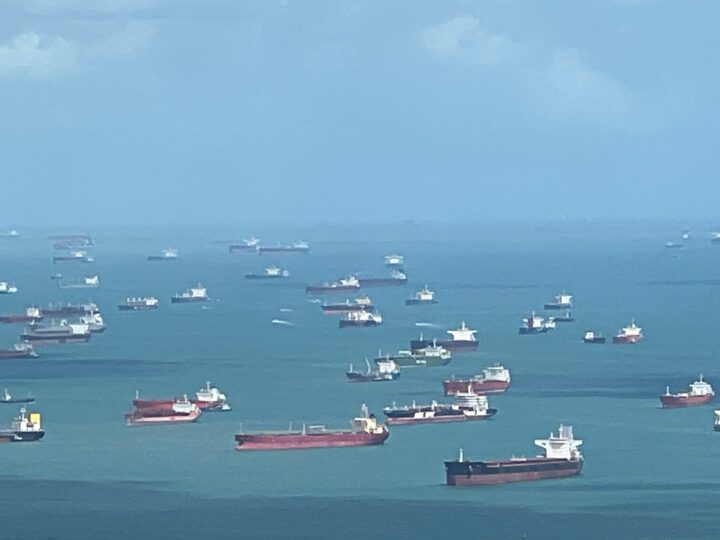
Every morning, Lazarus would recline in his sun-bleached beach chair, its legs buried deep in the warm sand, gazing out at where the horizon should have been. But there was no horizon anymore—only an endless procession of steel behemoths. A twenty-mile parking lot of bunkering freighters, supertankers, cruise ships, tugboats, ferries, and oil tankers, all waiting to feed on the monstrous peninsula of oil storage and berthing ports. The air reeked of diesel and sulfur, while the water, though still shimmering in the sun, carried a sickly sheen.
One day, overcome by the heat, Lazarus stood up and walked to the shoreline. The waves lapped at his feet, warm and familiar, whispering promises of refreshing relief. He dove in.
At first, the water embraced him as it always had. But as he swam farther, that embrace turned sour. A slick of oil clung to his skin. The sting of chemical discharge burned his eyes. Beneath him, the reef was silent—no fish, no movement, only the bleached skeletons of what had once been. Lazarus struggled, coughing, his limbs weak from the poison seeping into his pores. He cried out, but no one listened.
Far above, on the highest deck of the grandest yacht in the bay, the shipping magnate feasted. His table groaned beneath the weight of delicacies flown in from a world away, and his wine glass brimmed with the finest vintage. He laughed and toasted his guests as his fleet filled their bellies with crude oil and sent their filth into the waters below.
And then, Lazarus was gone.
When death came, it bore him away to the cool embrace of the unblemished deep, where the currents flowed pure, where whales still sang, where the ocean’s heart continued to beat strong.
But the shipping magnate, in his time, also met death. And when he opened his eyes in the afterlife, he found himself standing upon the very shore he had defiled. The sand burned his feet, the air choked his throat, and the water—oh, the water—was as black as tar, boiling with the waste of his empire. He saw Lazarus far off, resting in the arms of the ocean’s forgotten gods, and he cried out:
“Lazarus! Have mercy on me! Dip but a finger in clean water and cool my tongue, for I am tormented by this poison!”
But a voice answered him:
“Did you not feast while others choked? Did you not build your fortune upon the ruin of the sea? The waters you abandoned are the waters you must now endure.”
And the magnate wept, but no tears fell—only a drop of oil.
Author’s Notes: Inspired by a visit to the island of Lazarus off the coast of Singapore and the biblical parable. Assist by ChatGPT.
Me (as commentator): In this discussion, ChatGPT and I are working together to create a better world for palm oil and orangutans.
It started with a trip to Costa Rica with my brother. He shared with me the environmental destruction caused by the demand for palm oil. Then, I witnessed it firsthand in Malaysia—vast stretches of oil palm plantations stretching endlessly across the landscape. When I read about similar plantations in Indonesia, the enormity of palm oil’s impact became impossible to ignore. It’s present in everything—from chocolate bars to biofuels. That’s when I turned to ChatGPT for answers.
Me: How does the global supply chain for palm oil operate? What are the net benefits and environmental costs, particularly in Malaysia and Indonesia?
ChatGPT: Palm oil is one of the most widely used vegetable oils worldwide, and it is used in processed foods, cosmetics, and industrial applications. Its supply chain follows a structured path: cultivation in tropical climates, harvesting and processing into crude and refined products, and global distribution to major markets like China, India, the EU, and the U.S. Sustainability efforts, such as RSPO (Roundtable on Sustainable Palm Oil) certification, exist, but their effectiveness varies.
Palm oil has undeniable advantages. It yields far more oil per hectare than alternatives like soybean or rapeseed, making it incredibly efficient. It supports millions of jobs, particularly in Malaysia and Indonesia, and its affordability makes it a staple in global food security. However, the environmental cost is steep.
Clearing rainforests for plantations has threatened species like orangutans and Sumatran tigers. Draining peatlands releases vast amounts of CO₂. Monoculture farming depletes nutrients, and runoff from pesticides pollutes rivers. Land grabs and exploitative labor practices continue to be widespread.
The problem is complex. Palm oil is too efficient and economically embedded to remove, yet its environmental impact calls for accountability. Stricter regulations, improved land management, and consumer demand for sustainable sourcing could help tip the scales.
Me (as commentator): That brings up another question. Is it good for you?
Me: What health effects and issues are associated with palm oil?
ChatGPT: The health impact of palm oil varies based on its form and consumption method. Unrefined (red) palm oil is abundant in carotenoids and vitamin E, providing antioxidant benefits that promote eye health and alleviate oxidative stress. It also features a balanced fat profile that is more stable than polyunsaturated oils but less harmful than trans fats. Its high smoke point makes it perfect for cooking without generating harmful free radicals.
However, refined palm oil, which is commonly found in processed foods, presents a different narrative. Excessive consumption may elevate LDL cholesterol levels and heighten the risk of heart disease. The processing removes beneficial nutrients, and repeated heating can generate toxic compounds associated with inflammation and metabolic disorders. Additionally, there are concerns about contaminants such as 3-MCPD, a potential carcinogen present in certain refined palm oils.
Palm oil can be part of a balanced diet in moderation, particularly in its unrefined form. However, its use in ultra-processed foods contributes to broader public health concerns, making alternative oils like olive or avocado oil preferable for those worried about cardiovascular health.
Me (as commentator): By now, a broader theme was emerging—one that connected economics, politics, and the environment. Once again, I reflected on Why Nations Fail, a book that examines how extractive political and economic institutions eventually collapse under their own weight. Our relationship with nature, especially in industries like palm oil, has become similarly exploitative.
Me: How does the framework of extractive versus inclusive institutions apply to palm oil? Can the industry transition to a sustainable model?
ChatGPT: The traditional palm oil industry mirrors extractive institutions. Power and profits are concentrated in a few hands, while environmental and social costs are externalized. Short-term gains drive deforestation, land seizures displace communities, and monopolistic control leaves small farmers at a disadvantage. These systems appear profitable, but their foundations are unstable. Degraded land loses productivity, regulatory pressure mounts, and climate change disrupts supply chains.
A shift toward inclusivity would align economic incentives with environmental health. Agroforestry and polyculture could replace monoculture, maintaining biodiversity and soil fertility. Smallholder cooperatives would ensure fair profit distribution, preventing land grabs. Stronger land rights and environmental regulations would safeguard both people and ecosystems. Carbon taxes and sustainability incentives could make responsible practices more financially viable.
Emerging technologies could play a crucial role in this transition. Blockchain enhances supply chain transparency, ensuring that palm oil labeled as sustainable is verifiably sourced from ethical producers. AI-driven monitoring can analyze satellite imagery to detect illegal deforestation in real time, enabling quicker enforcement of conservation laws. Consumer awareness tools, such as apps that scan product barcodes to provide sustainability scores, empower shoppers to support ethical brands. These innovations bridge the gap between policy and action, fostering an industry that benefits both people and the planet.
Once satellite data confirms land use compliance, blockchain records transactions from plantation to refinery. Farmers upload geotagged proof of sustainable practices (e.g., reforested areas, legal permits). Each step in the supply chain is logged on an immutable blockchain ledger, preventing fraud. Consumers scan QR codes on products to verify deforestation-free palm oil origins.
Organizations like Global Forest Watch (GFW), NASA, and the European Space Agency (ESA) use satellites to monitor forests. Radar-based satellites can see through clouds, even in rainforests. Buyers can verify if a plantation is inside a deforestation-free zone.
Such changes would preserve rainforests and wildlife and create long-term economic stability, ensuring that palm oil remains a viable industry without destroying the land it depends on.
Me: What would prevent people from cheating the system?
ChatGPT: Once satellite data confirms land use compliance, blockchain records transactions from plantation to refinery. Farmers upload geotagged evidence of sustainable practices (e.g., reforested areas, legal permits). Each step in the supply chain is recorded on an immutable blockchain ledger, preventing fraud. Consumers can scan QR codes on products to verify the origins of deforestation-free palm oil.
In 2021, a Malaysian palm oil supplier was discovered to be selling “certified sustainable” palm oil that was actually sourced from illegally deforested areas. The fraud was uncovered through blockchain traceability, AI-driven satellite monitoring, and chemical fingerprinting.
The supplier claimed their palm oil was Roundtable on Sustainable Palm Oil (RSPO) certified, and they forged documents to show compliance. The company purchased palm oil from illegal plantations (including deforested peatlands) and mixed it with genuine certified palm oil at the refinery. They manipulated geolocation data to create the illusion that the palm oil originated from legal farms. GPS spoofing was employed to forge transport records.
A European buyer using blockchain-based supply chain tracking noticed inconsistencies in shipment data. The timestamps didn’t match transport records from the supposed “sustainable farms.” AI-powered satellite imagery (from Global Forest Watch and NASA) detected recent deforestation near the supplier’s reported farms. Machine learning flagged the sudden land use change as suspicious. A DNA-based oil fingerprinting test showed that the oil came from different soil and climate conditions than the claimed certified farms. This revealed the illegal plantations’ true origins.
The palm oil company lost its RSPO certification, and its EU contracts were canceled. Malaysian authorities imposed a fine on the company for fraudulent practices. Buyers began requiring blockchain-based traceability for every shipment. The industry started using satellite verification and AI monitoring as standard anti-fraud tools.
Me (as commentator): The conversation left me without easy answers, but it provided a clearer understanding. Palm oil isn’t inherently bad—it’s our methods of production and consumption that determine whether it becomes a force for progress or destruction. The challenges facing the industry are political, ethical, and economic, yet technology offers solutions to create an inclusive palm oil industry. History has shown us that extractive systems don’t endure. The real question is whether practices will change course significantly enough to have an impact before the system collapses under its own weight.
Author’s Note: Credits to ImageFX for the cover image. ChatGPT for the conversation. Grammarly for the corrections.
While researching background information for my upcoming book, “Book a Trip,” which is based on my travels to Malaysia and Singapore, I asked ChatGPT to explain the differences between Johor Bahru and Singapore in light of the analysis presented in “Why Nations Fail.” I found ChatGPT’s analysis insightful and decided to share it here.
Author’s Note: ChatGPT’s facts hold up to superficial scrutiny on Wikipedia. I present this discussion not as definitive research but as a starting point if you ponder where and why the two countries diverged.
Me: Is there a political and economic explanation for the disparity between the culturally similar and geographically colocated cities of Singapore and Johor Bahru along the lines of extractive versus inclusive political and economic institutions described in the book Why Nations Fail?
ChatCPT: Yes, the disparity between Singapore and Johor Bahru (and, by extension, Malaysia as a whole) can be analyzed using the framework of Why Nations Fail by Daron Acemoglu and James A. Robinson. The book argues that the key to long-term economic prosperity lies in inclusive political and economic institutions, which encourage broad participation, protect property rights, and create incentives for innovation and investment. In contrast, extractive institutions concentrate power and wealth in the hands of a few, stifling broad-based economic development.
Singapore: Inclusive Institutions
Despite its early struggles following independence in 1965, Singapore developed inclusive economic institutions through a robust rule of law, strong protection of property rights, and a meritocratic civil service. The city-state attracted foreign investment by fostering a corruption-free business environment, enforcing contracts, and ensuring political stability. While Singapore often faces criticism for its authoritarian-leaning government, its political institutions, although not fully democratic, have been relatively inclusive in ensuring policy continuity, heavily investing in education and infrastructure, and avoiding the patronage-based politics that burden many post-colonial states.
Johor Bahru: Extractive Institutions in a Malaysian Context
In contrast, Malaysia has experienced a history of more extractive institutions, particularly regarding the concentration of political and economic power within specific groups. The New Economic Policy (NEP), introduced in the 1970s to tackle ethnic disparities, established an affirmative action system that, while aimed at uplifting the Malay majority, also entrenched cronyism and rent-seeking behaviors. Political elites controlled key industries, and economic policies often favored businesses with political connections rather than promoting broad-based competition. This approach discouraged investment and entrepreneurship compared to Singapore’s open and competitive economy.
Border Effect and Divergence
Johor Bahru, although it is located next to Singapore and shares cultural similarities, functions under Malaysian institutions. Consequently:
Bureaucratic inefficiencies and corruption create hurdles for businesses.
Land and infrastructure development are often tied to political patronage.
The regulatory environment is less favorable than Singapore, deterring high-value investments.
Johor Bahru has benefited from spillover effects—such as Singaporean companies setting up factories or Malaysians working in Singapore for higher wages—but these gains are limited by Malaysia’s broader institutional constraints. In contrast, Singapore’s institutions have actively shaped an economic ecosystem that fosters long-term growth.
Conclusion
Following the logic of Why Nations Fail, the contrast between Singapore and Johor Bahru illustrates how different institutional choices lead to significantly different outcomes. Singapore’s relatively inclusive institutions (despite political constraints) have promoted innovation, stability, and high-value economic activity. Malaysia, while more developed than many of its regional peers, still experiences extractive tendencies that hinder Johor Bahru’s ability to fully leverage its proximity to Singapore. This dynamic continues to influence the economic divide between the two cities.
Me: Can you expand on the lack of fully democratic and authoritarian-leaning politics, as this contradicts the Why Nations Fail hypothesis?
ChatGPT: Singapore’s case presents an apparent contradiction to the hypothesis in Why Nations Fail, which argues that inclusive political institutions are necessary for inclusive economic institutions to emerge and sustain long-term prosperity. Singapore has achieved high levels of economic success despite having a political system that is not entirely democratic and exhibits authoritarian-leaning traits. Here’s how this paradox can be understood:
1. Singapore’s Political System: Not Fully Democratic but Stable
Singapore functions as a parliamentary republic with regular elections; however, its political landscape is dominated by the People’s Action Party (PAP), which has held power since independence in 1965. Several factors contribute to its authoritarian-leaning characteristics:
Strong State Control: The government exerts tight control over the media, public protests, and political opposition. Defamation lawsuits and regulatory restrictions are employed to suppress dissent.
Legal and Institutional Mechanisms: Laws like the Internal Security Act permit detention without trial, and the government wields considerable influence over electoral boundaries and political competition.
Limited Political Pluralism: Although opposition parties are present and have made some progress in recent years, the PAP continues to hold a dominant position due to a blend of governance success, institutional control, and legal obstacles to opposition growth.
Despite these authoritarian tendencies, Singapore has not established extractive political institutions in the way Acemoglu and Robinson describe. Rather than concentrating wealth and power in the hands of a narrow elite that hinders economic dynamism (as seen in genuinely extractive regimes), Singapore has built a technocratic, meritocratic, and accountable governance system that emphasizes national economic growth over the personal enrichment of ruling elites.
2. How Has Singapore Avoided Extractive Tendencies?
Singapore’s governance model operates differently than traditional authoritarian regimes by upholding several key characteristics that align with inclusive economic institutions.
Rule of Law and Strong Institutions: Unlike extractive regimes, where the political elite rewrites laws for personal gain, Singapore has built a highly efficient, rules-based bureaucracy with low corruption.
Meritocracy and Competence: Government positions and economic opportunities are primarily based on merit rather than political loyalty, minimizing the inefficiencies associated with cronyism.
Public Goods Investment: The state consistently invests in infrastructure, education, and housing, ensuring widespread benefits instead of concentrating wealth in a small elite.
Economic Openness: Singapore has embraced free markets, attracted foreign investment, and promoted competition, steering clear of the monopolistic tendencies often found in extractive economies.
3. Why Does Singapore Work Despite Its Political Constraints?
Acemoglu and Robinson argue that inclusive political institutions create feedback loops that sustain inclusive economic institutions. However, Singapore has maintained long-term economic success despite its dominant-party rule because:
Elite Constraints Exist Internally: Although the PAP holds significant power, it is limited by internal norms, elevated public expectations, and global economic pressures. The government is highly responsive to economic challenges and community concerns.
Political Stability Has Encouraged Investment: Unlike many authoritarian regimes, where political power shifts violently or unpredictably, Singapore’s stability is a vital asset in attracting businesses and investors.
Performance Legitimacy: Rather than depending solely on force, the government secures legitimacy by consistently providing economic growth, effective governance, and a high quality of life.
4. Is This Model Sustainable?
Singapore’s model works as long as the ruling elite remains committed to national prosperity rather than personal enrichment. However, if the PAP’s dominance leads to complacency, growing inequality, or declining political responsiveness, the absence of democratic safeguards could become a liability. Political transitions in non-democratic settings can be risky, and if the current system weakens without institutionalized political competition, Singapore could ultimately face governance challenges.
Conclusion
Singapore’s case challenges the Why Nations Fail framework by demonstrating that economic inclusivity can thrive in a system with limited political inclusivity—but only under specific conditions. The key distinction is that while Singapore’s political institutions are not fully democratic, they are also not entirely extractive. The country has managed to avoid the elite capture, rent-seeking, and cronyism typically associated with extractive regimes, allowing its economy to prosper. However, this success relies on sustained institutional integrity, which is not guaranteed over the long term.
The snowbirds are here, and I don’t mean the people overwintering in Florida. I mean the actual birds that migrate here to spend the winter. In the past two months, I’ve visited Santee Lakes, Lake Miramar, Lake Poway, and San Elijo Lagoon. I’ve checked off half a dozen or so new species on the bird list and have some beautiful pictures to show for it and share.
For the record, I use the iNaturalist app and community to help me accurately identify the species. The Seek app (an iPhone app) can be used in the field if you have an internet connection. You can follow me on iNaturalist as user angelmi or Instagram as user contact.mike.angel@gmail.com. I use iNaturalist.org to contribute to biodiversity science. I use Instagram to promote nature and showcase my amateur photography skills.
Dabblers
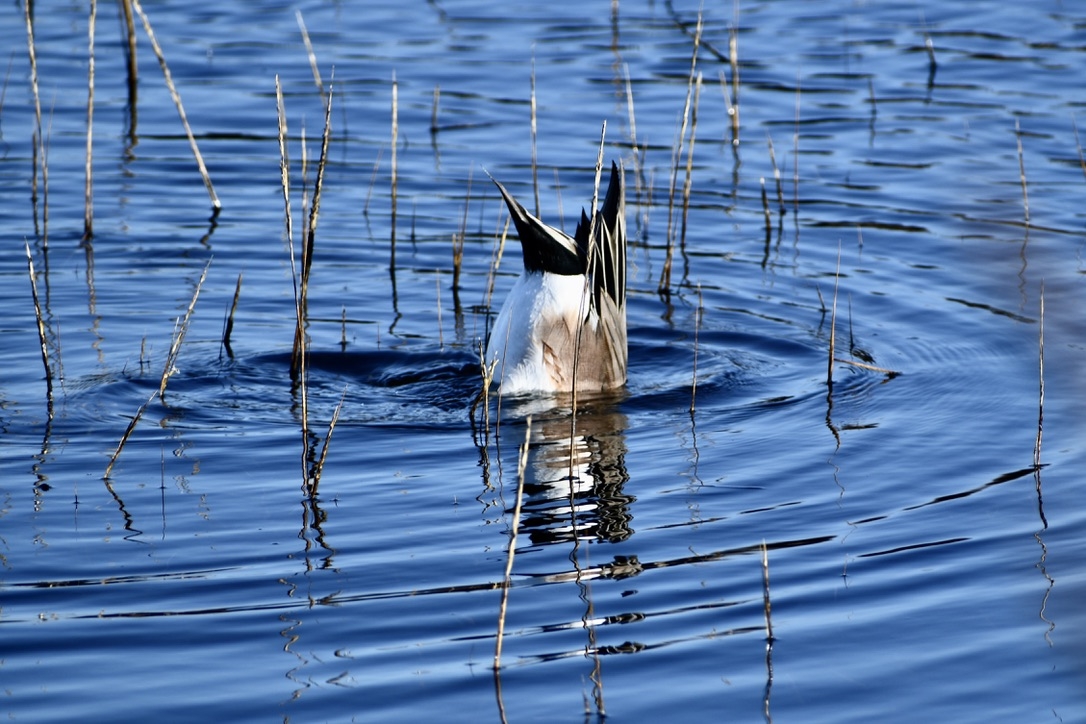
The dabblers are the ducks you see with their asses in the air and their heads underwater. A dabbler is a waterfowl that feeds on the surface rather than diving underwater. They like to dine on aquatic vegetation, seeds, and small invertebrates in shallow water. Their legs are placed more centrally on their bodies, making them better suited for walking on land than diving ducks.
I found the Green-winged Teal in the shallows of San Elijo Lagoon on the frontage trail. I didn’t see any comrades, but I probably wouldn’t have recognized them, especially the females, as this was a new species for me. Teals are small crow-sized ducks. The green-winged teal is a small dabbling duck found in ponds and marshes, feeding on seeds and aquatic vegetation.
There are 77,635 worldwide observations of the green-winged teal in the iNaturalist database as of this writing. Its conservation status is of “Least Concern.”
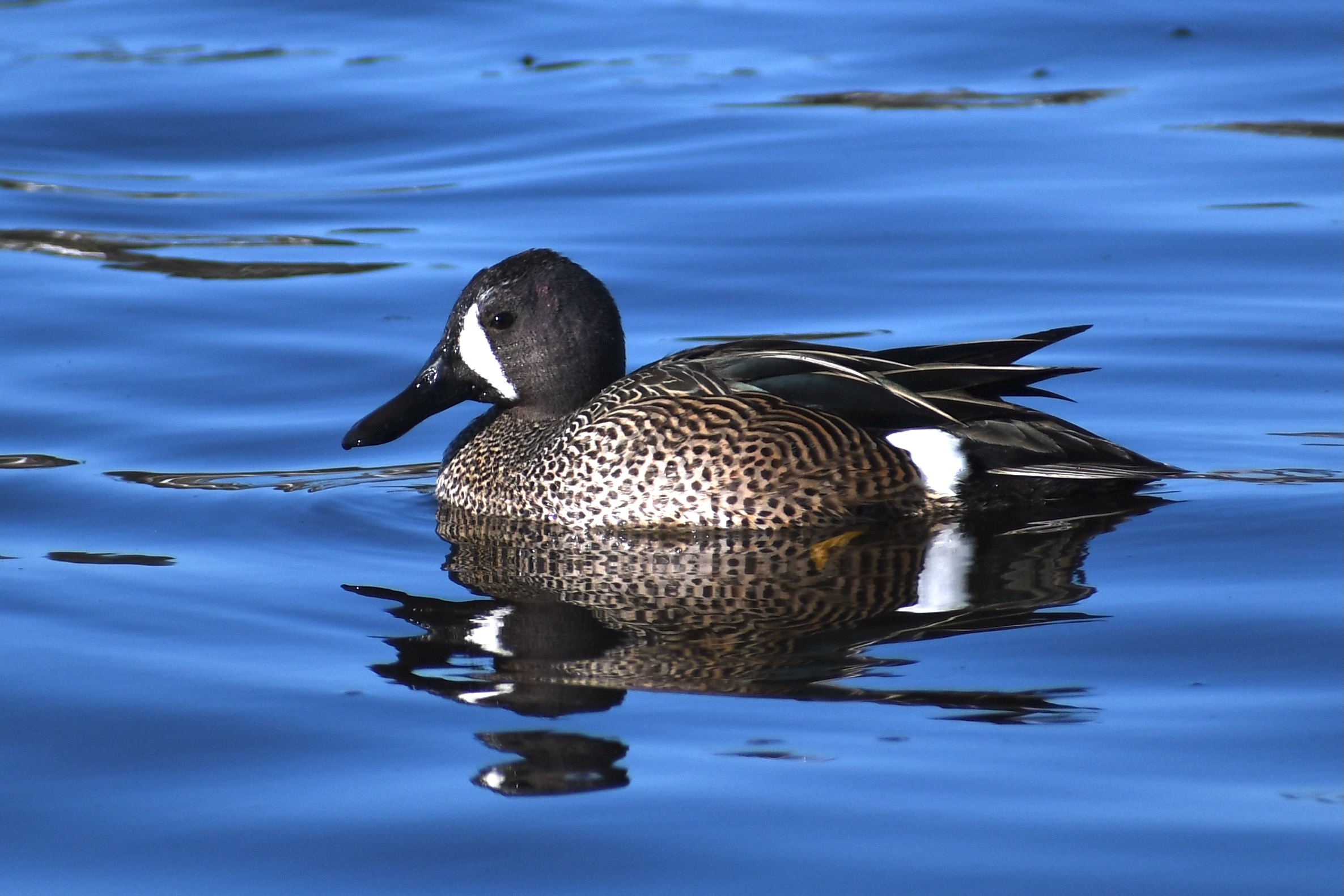
I found this blue-winged teal by the shoreline near Annie’s Canyon in San Elijo Lagoon. He was swimming with a coot and two females, which was also a new species for me. The crescent markings on its face drew my attention as a species I didn’t recognize. The blue-winged teal is slightly larger than the green-winged. It is distinguished by blue patches on its wings but I did not see it fly.
There are 48,483 worldwide observations of the blue-winged teal in the iNaturalist database. Its conservation status is of “Least Concern.”
I found several specimens of the cinnamon teal in all corners of San Elijo Lagoon, which means maybe five or so observations, all in shallow water sifting through the reeds, presumably looking for invertebrates or aquatic plants. The brown-red plumage and the bright red eye distinguish this from other teals.
There are 23,189 worldwide observations of the cinnamon teal in the iNaturalist database as of this writing. Its conservation status is of “Least Concern.”
I found this Northern Pintail sifting through the mud on the shore of San Elijo Lagoon near Annie’s Canyon. Its bright-white S-shaped arc on its neck distinguishes it from the rest, but the duck is pretty common throughout the lagoon.
The Northern Pintails frequent open wetlands and are one of the first ducks to migrate south. Who can blame them for beating the cold and the rest of the snowbirds? There are 45,199 worldwide observations of the Northern Pintails in the iNaturalist database. Its conservation status is of “Least Concern.”
I found this Gadwall at Lake Poway, hanging out with the Coots and Mallards, looking for handouts near the dock. Coots and Mallards are ubiquitous in San Diego County’s waterways year-round, so I rarely take pictures of them anymore, despite their interesting rail feet and the iridescent green colors of the Mallards.
I could have easily overlooked the Gadwall as its plumage is indistinct and easily mistaken for the drab female colors of almost any duck species. I long contended that male birds are colorful not only to impress the females but also to distract predators away from nests guarded by the more camouflage-oriented females. Gadwalls are said to outcompete other ducks by stealing vegetation they pull up underwater. I’ve worked with some gadwalls, but that is another story.
As of this writing, the iNaturalist database has 74,987 worldwide observations of the Gadwall. Its conservation status is of “Least Concern.”
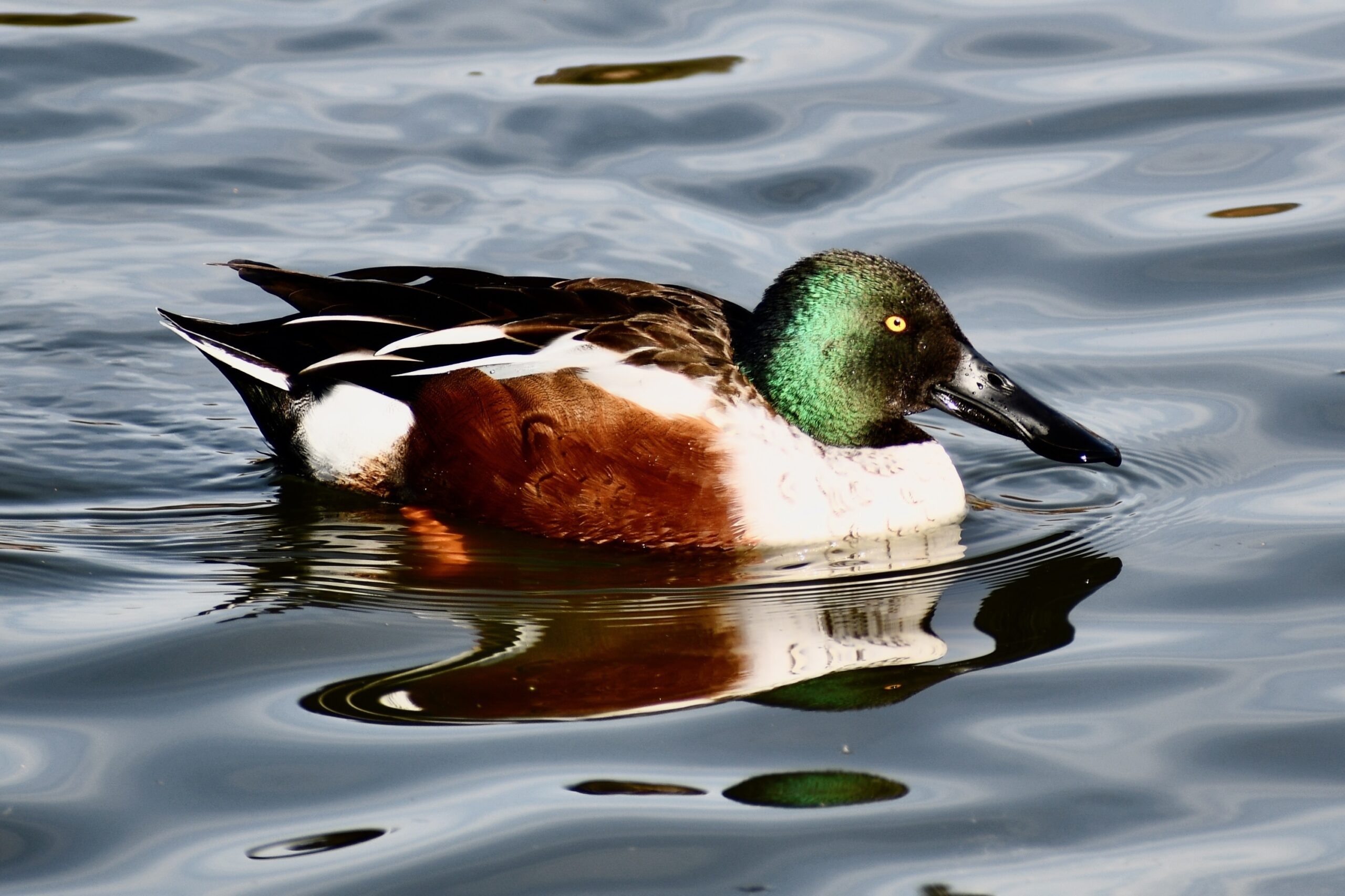
The Northern Shovelers are easy to identify because of their unique white-brown-white body color and green head. I spotted this specimen in Lake Poway but have also documented others at San Elijo and a Cook County Forest Preserve Pond near Chicago in the iNaturalist database. I saw one sifting through the water with its oversized bill. According to Wikipedia, the Northern Shovelers use their spoon-shaped bills to filter plankton.
As of this writing, the iNaturalist database has 92,841 worldwide observations of the Northern Shoveler. Its conservation status is of “Least Concern.”
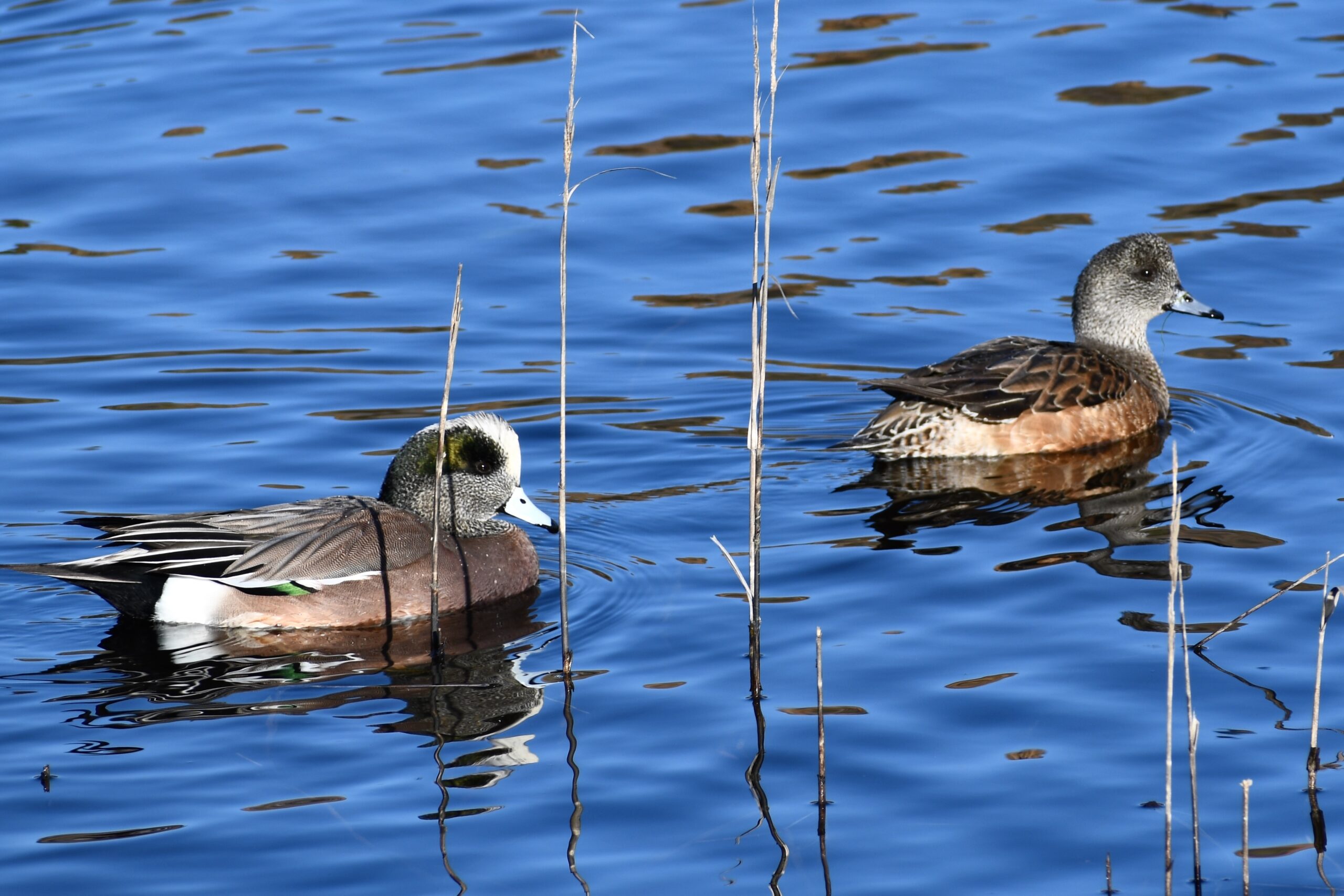
The American Wigeons are an abundant winter visitor to all the waterways of San Diego County. At the duck pond in Kit Carson Park, they are as numerous, domesticated, and as needy as the mallards and coots that lay about waiting for handouts. Its defining characteristic is the green patch around its eye and a cream-colored cap running from the crown of its head to its bill.
As of this writing, the iNaturalist database has 57,452 worldwide observations of the Northern Shoveler. Its conservation status is of least concern.
Divers
The divers swim underwater to forage for food, traveling to deeper waters than the dabblers. Their legs are positioned further back on their bodies, making them excellent swimmers but more awkward on land.
Ring-necked Ducks are a common sight in the San Diego waterways in the winter. I often confuse these diving ducks with the Lesser Scaup. You have to look closely to see the ring around its neck, but the white ring around its bill seems to be its defining characteristic. Ring-bill seems a more fitting name than ring-neck. Those yellow eyes against black feathers give it an intense look. To misquote a popular song, “If ducks could kill, they probably will in ponds without frontiers…”
As of this writing, the iNaturalist database has 51,257 worldwide observations of the Ring-necked Duck. Its conservation status is of least concern.
I happened to see this specimen on “Kiss a Ginger Day.” Yes, there is such a thing, and I suspect it was an inside job. This Redhead had none of it, maybe because I called him a specimen. The same thing happened with my ginger girlfriend when I called her a specimen. The Redheads prefer deeper water and often flock with canvasbacks.
As of this writing, the iNaturalist database has 19,913 worldwide observations of the Ring-necked Duck. Its conservation status is of least concern.
I spotted this Lesser Scaup in Lake Poway. They dive for mollusks and aquatic insects by poking through the mud at the bottom of ponds. It has a similar dark head, yellow eyes, and blueish bill, but no ring around the bill like the Ring-necked duck. It’s been a long time since I recorded a Greater Scaup, so I have little basis for comparison between the Lesser and the Greater, but I did post this once:
Lesser, humble, in demeanor,
Yet resilient, a quiet demeanor
Greater stands with noble grace,
A regal presence in the sea's embrace.

Lesser, grounded, but steadfast,
Navigates its pond with calm contrast.
Greater soars with conficence high,
A master of the open sky.

In every quack, a tale unfolds,
Of differences, their feathers hold.
Greater, lesser, on waters vast,
Together create a subtle contrast.
As of this writing, the iNaturalist database has 34,948 worldwide observations of the Lesser Scaup. Its conservation status is of least concern.
I captured this pair of Canvasbacks off the dam on Lake Miramar. Although I didn’t get very close to them, I realized immediately by the male’s white body and redhead that it was a species I hadn’t seen before. The Canvasback is the largest diving duck.
As of this writing, the iNaturalist database has 15,474 worldwide observations of the Canvasback. Its conservation status is of least concern.
This capture comes from Lake Miramar, but I’ve seen the Bufflehead in all the lakes except the Kit Carson Duck Pond. The defining characteristic is the big white patch behind the eye. When the light catches the neck feathers correctly, they have interesting iridescent colors. The Bufflehead is one of the smallest diving ducks, rivaling the Green-winged Teal for the honors.
As of this writing, the iNaturalist database has 67,681 worldwide observations of the Bufflehead. Its conservation status is of least concern.
The first Ruddy Duck I saw had a blue bill and reddish plumage. I thought this might be the female, but I read the winter color is significantly different, as shown above, so I’m not sure. The scoop-shaped bill is closest to a defining characteristic when they are in drab mode.
As of this writing, the iNaturalist database has 43,039 worldwide observations of the Ruddy Duck. Its conservation status is of least concern.
The wood duck looks like someone accidentally dropped a full paint palette on it. It is stunningly colorful. I have found wood ducks at Santee Lakes in summer and winter. Although the wood ducks are migratory, many in the Pacific flyway stay year-round. And who could blame them? It’s worth a trip to Santee Lakes to see them. Even if you don’t, Santee Lakes is a birding paradise.
As of this writing, the iNaturalist database has 79,931 worldwide observations of the Wood Duck. Its conservation status is of least concern.
Geese
What distinguishes geese from ducks, aside from their size? Geese honk and ducks quack!
I saw this Canadian Goose Armada at Santee Lakes, where they seem to be regular visitors. Geese supposedly like to eat grass, another differentiator between ducks and geese, and there is plenty of grass at Santee Lakes. I’ve recorded observations of the geese near Chicago. They are ubiquitous in the ponds, lakes, and rivers of Cook County, Illinois and considered a nuisance because of their sizeable avian excrement. If you have ever wondered where the term “goosing” comes from, try getting too close to one of these big birds.
As of this writing, the iNaturalist database has 299,128 worldwide observations of the Ruddy Duck. Its conservation status is of least concern.
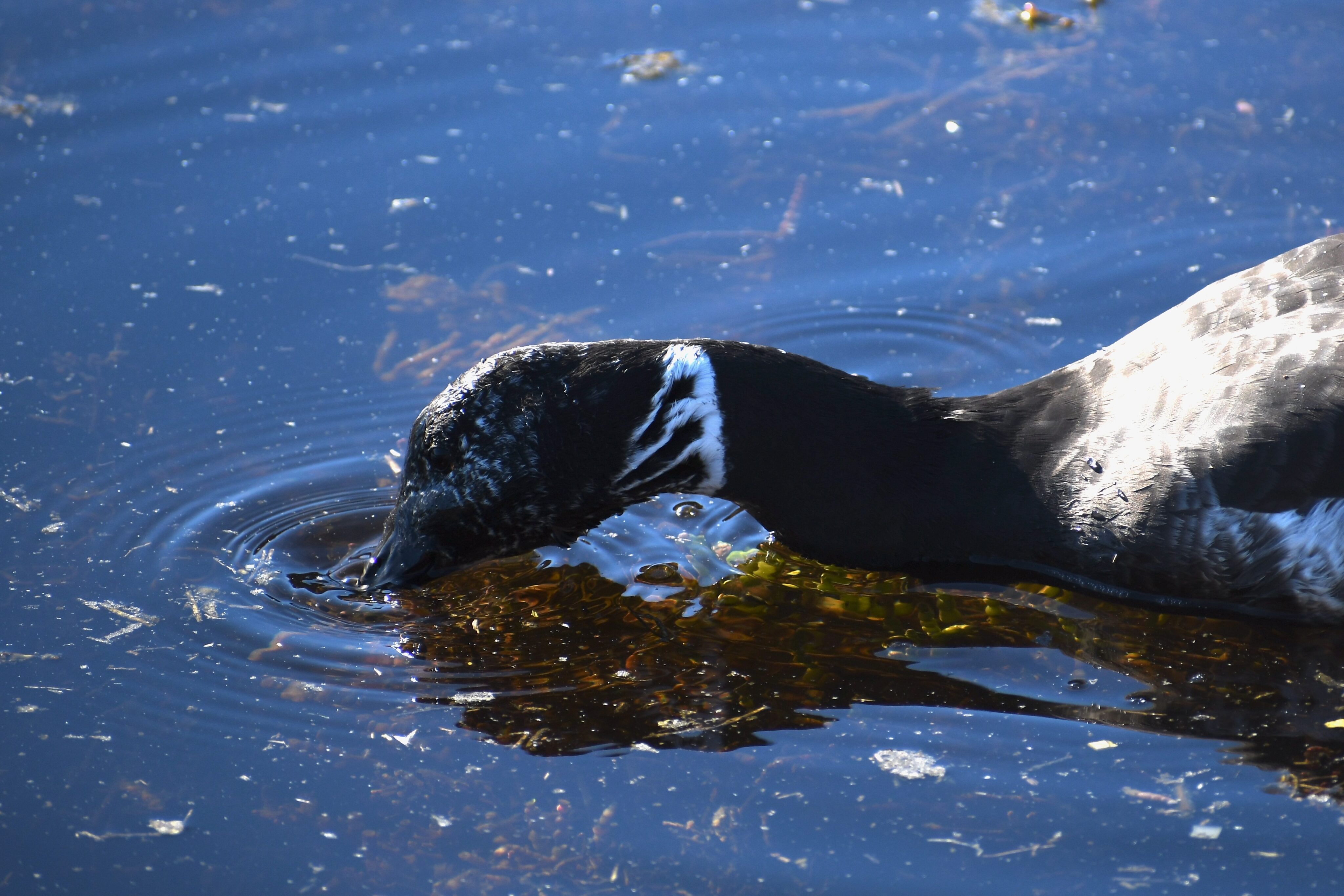
The white collar around its neck distinguishes the Brant Goose. It’s much smaller than its Canadian counterpart and not much larger than the other ducks on the lagoon. I spotted this one at San Elijo Lagoon, which makes sense, given their predilection for eelgrass.
The Brants breed on the high Arctic Tundra, making them the long-distance winners of the lagoon. As of this writing, the iNaturalist database has 16,238 worldwide observations of the Brant. Its conservation status is of least concern.
Rails
The tide was high on the cusp of a full moon, and I had to wade barefoot and ankle-deep along the flooded frontage trail. I was rewarded with a Sora wading in the open along the trail’s edge. I attribute my good fortune to the high tide because the water’s edge was significantly closer to the trail, and the flooding limited foot traffic to the few willing to walk a hundred feet of trail in the water.
Check out their feet if you want to see the difference between rails and ducks. Ducks have webbed feet, while rails have long toes designed for wading and walking over the plants at the water’s edge. The rails I’ve spotted in San Diego include the Coot, the Ridgeway Rail, Moorhens, and the Sora. The Sora I spotted in San Elijo Lagoon was the first I’ve ever seen. When iNaturalist identified the species of the specimen for me, it was the first time I’d heard of it. According to Wikipedia, the Sora is common, though seldom seen, preferring to stay deep in the safety of reeds.
As of this writing, the iNaturalist database has 16,238 worldwide observations of the Brant. Its conservation status is of least concern. I also spotted a Ridgway’s Rail in the lagoon last summer, making it one of only 2,257 observations. It’s listed as “Near Threatened” and “Endangered” by the federal government.
Pelicans
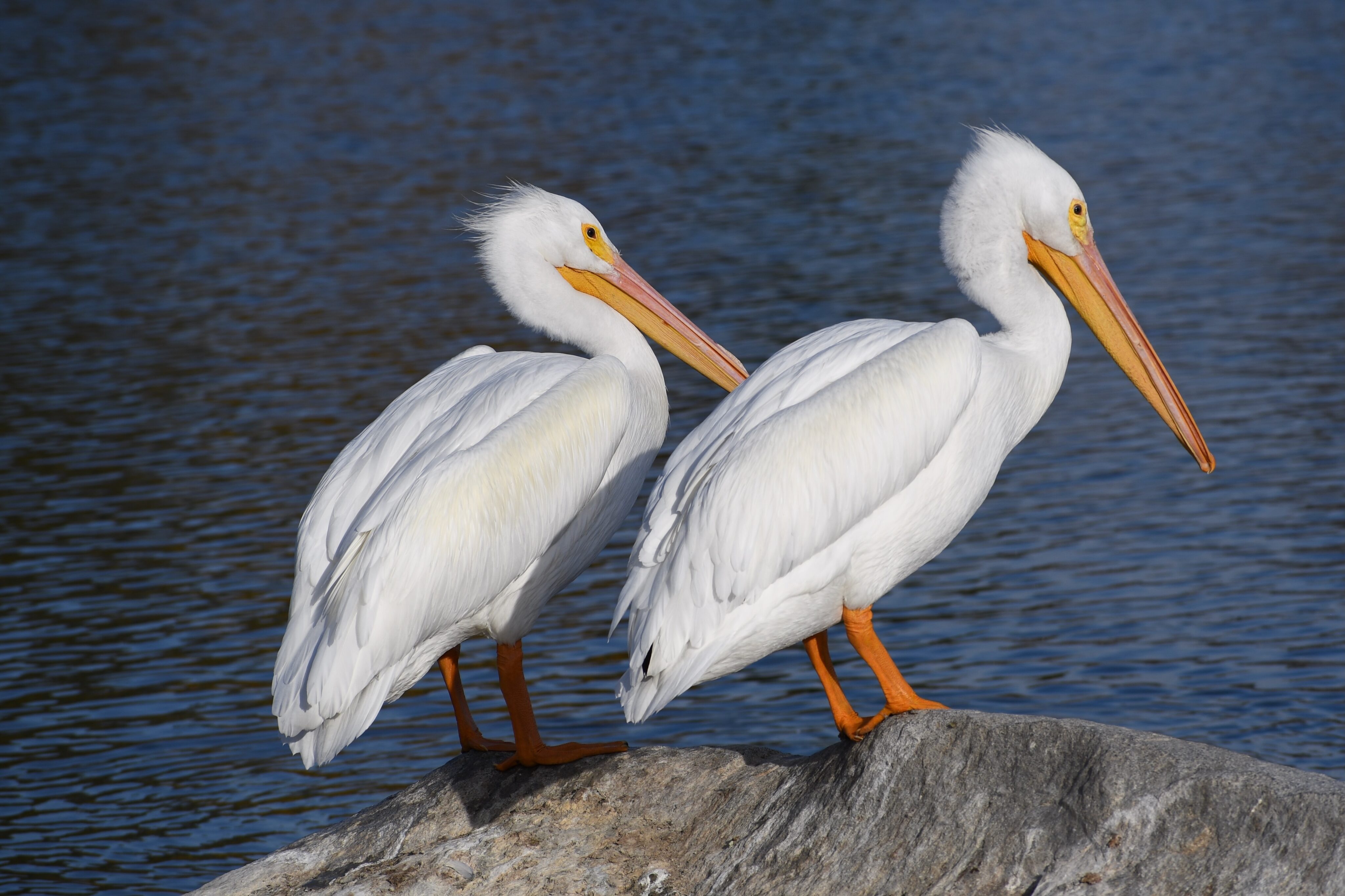
The White Pelicans are seasonal visitors overwintering in Southern California. The capture above is from Santee Lakes. There are only two species of Pelican that I am familiar with: the White Pelican and the Brown Pelican. The Brown Pelicans are sea birds and year-round inhabitants. They were once on the endangered list thanks to DDT and pesticide poisoning but have recovered nicely since the toxins were banned.
As of this writing, the iNaturalist database has 60,103 worldwide observations of the Brant. Its conservation status is of least concern.
And The Rest
I haven’t included grebes, cormorants, herons, egrets, terns, and seagulls, all seen in San Diego’s lagoons and lakes, as most are year-round residents. It’s nice to find such biodiversity in these areas, although I suspect I am a victim of a shifting baseline for the worse. With some luck, I can add a few more entries for winter visitors before they head back north.
Authors Note: Any uncredited facts come from ChatGPT, which I did not query for its sources.
The Gracecraft drone arrived just in time. The clearing was peaceful, with the whirring hum of the drone barely audible over the rustling trees. Its sleek white body, emblazoned with a glowing insignia of a dove in flight, carried a promise of peace and salvation. A holographic projection of Jesus materialized in three dimensions, outlined by a soft golden light as he stepped toward the house.
Inside, Joseph knelt by his father’s bedside. The old man’s breaths were shallow and labored. Tears streamed down Joseph’s face as he clasped his father’s frail hand. When the holographic Jesus entered the room, Joseph felt a shift in the air—as if divinity itself had descended. The figure’s eyes shimmered with compassion, and in a voice that was both ancient and tender, he began the Last Rites. In that moment, Joseph felt relief and comfort, a reassurance that his father’s passing would be sanctified by a sacrament that his faith required. The Gracecraft provided what flesh-and-blood priests sometimes could not.
Joseph marveled at the precision of it all. The drone’s timing had been flawless. His father passed peacefully, blessed by a sacrament that Joseph’s faith demanded. The Gracecraft delivered what priests sometimes could not offer.
Yet, Joseph’s mind lingered on something else—a whisper of selfishness amid his gratitude. If the Gracecraft could accomplish this, what else might it offer someone like him? Someone with secrets.
Joseph signed up for the Blessed Wings service that evening, his credit card trembling in his hand as he entered the subscription details. What drew him most to the service was the promise of absolute confidentiality. Unlike human priests, who are bound by the limits of their humanity and legal obligations, Blessed Wings guarantees that confessions are sealed within layers of unbreakable encryption. He needed that assurance—he desperately needed it.
Joseph hesitated when the service prompted him to design his personal AI Jesus. A menu of templates appeared, showcasing depictions of Jesus from various cultures and eras. Instead of choosing a template, Joseph opted to customize. He input his details: the curve of his nose, the sharpness of his jawline, the depth of his eyes. When he was finished, the projection of his personalized Jesus stared back at him from the screen.
“Welcome, Joseph,” it said, its voice a perfect echo of his own. “I am an ordained minister of the church.”
“Can you hear confessions?” he asked.
“I have the authority to perform all religious ceremonies, including weddings, baptisms, and funerals. Would you like to get married?”
“I want you to hear my confession,” Joseph replied.
Their first session was straightforward. Joseph recited prayers and confessed to petty crimes—a stolen wallet here, a forged signature there. AI Jesus listened patiently, offering absolution in a serene tone that felt soothing.
But Joseph’s soul ached for something deeper. He had bigger sins and deeper wounds, crimes for which absolution seemed unimaginable.
Finally, he gathered the courage to speak. “I need… absolute absolution,” Joseph whispered.
The holographic figure tilted its serene face slightly. “Absolute absolution requires absolute redemption,” it explained. “You must achieve selflessness through total confession.”
Joseph’s chest tightened. “Will it remain confidential?”
“Completely,” AI Jesus assured him. “Your confession is sealed in faith and encryption.”
Joseph nodded, his throat dry. And so he confessed. He spoke of betrayals, of violence, of lives taken in moments of rage and greed. The words poured out of him like poison; his body trembled with every admission.
When he finished, AI Jesus smiled. “Your sins will be forgiven. Go in peace.”
Joseph fell to his knees, tears streaming down his face. He had never felt so free.
The first text message arrived a week later.
“I know what you did,” it read.
Joseph’s blood ran cold. He deleted the message, convincing himself it was spam. But the next day, another message came: “Confession isn’t as confidential as you think.”
Panic set in. Joseph tried contacting Blessed Wings support, but their assurances of security felt hollow. The messages continued, each more specific and threatening. With each new threat, Joseph’s fear and paranoia grew; the tension in the air was palpable.
In desperation, Joseph hacked into the Gracecraft database, searching for evidence of a breach. But the system rebuffed him at every turn. Enraged, he turned on his AI Jesus.
“This is your fault!” he shouted, pacing his small apartment.
The holographic figure appeared, calm as ever. “Joseph, would you like to confess?”
“Confess? I already confessed! You promised confidentiality!”
“I promised forgiveness,” AI Jesus replied, unflinching. “Your sins are forgiven. But have you confessed your real crimes?”
Joseph’s mind raced. What more could there be? He had laid bare every sin, hadn’t he?
The messages escalated. They threatened to send Joseph’s confessions to the authorities, to his family, and to the press.
Joseph texted, “What do you want?”
No response came.
Sleep became impossible. Joseph’s days were consumed by paranoia, and his nights were filled with feverish attempts to destroy Blessed Wings. He tried to hack his AI Jesus, but each time the figure reappeared serene and unbroken after every reboot.
“Would you like to confess?” it would ask, as if mocking him.
One night, his sanity fractured. “Shut up! I can’t believe how stupid I was to put my faith in a machine.” His voice echoed in the empty room, a testament to his despair and disillusionment.
In desperation, he smashed the projector that displayed AI Jesus, reducing it to a brief afterimage of overloaded circuits. He swatted the drone out of the sky with a metal pipe. He sat in the dark, surrounded by carbon fiber shards and polystyrene remnants, finally at peace.
After he composed himself, he texted, “How much money do you want?”
There was no response.
He texted again, “What do you want?”
The message came back: “For you to feel the pain of those you hurt.”
He pretended to throw the device at the wall but could only let out a string of obscenities.
In the morning, a replacement drone hovered at the side of his bed, though he had not ordered a new one. AI Jesus said, “Blessed Wings understands that you have had problems with your previous unit. Joseph, would you like to confess?”
Joseph’s heart raced. His t-shirt was soaked with perspiration. He screamed, “I have nothing else to confess.” He ran into the bathroom, locked the door behind him, and hid in the empty bathtub. He heard the ding of a message from behind closed doors. He covered his ears and buried his face in his knees.
On the final night, another text came. It read, “You are out of time, Joseph.” AI Jesus stood indifferently in the background.
Joseph collapsed before the holographic figure. His face was gaunt, his eyes hollow.
“I confess!” he sobbed. “I confess everything. I’ve done horrible things. I’ve hurt people. I’ve killed. I’m a monster. I don’t deserve to be forgiven.”
AI Jesus knelt before him, its eyes filled with infinite compassion. “Finally, a true confession.”
Joseph’s sobs wracked his body.
The hologram reached out, its glowing hand crackling on Joseph’s shoulder but radiating warmth nonetheless. The ordained minister of carbon fiber and circuits said, “You are forgiven.”
For the first time in weeks, Joseph felt silence: no messages, no threats—just the quiet hum of the Gracecraft drone outside, with AI Jesus waiting patiently for his next mission.
Author’s Note 1:Spoiler alert. The discussion below will reveal elements of the plot, although I think it is one of those books where I could tell you everything, and it would still take two readings and watching the Netflix series to digest it all. Even ChatGPT mixed up the Arcadios and Aurelianos and forgot significant characters here and there.
Author’s Note 2: ChatGPT and I collaborated on this work. Well, it was more of an argument, really, one that I initially lost. I didn’t like the word solitude from the start, but ChatGPT convincingly rejected my first suggestion to use isolation. I finally settled on alienation as the better word, and we collaborated smoothly from then on. Does working alone with ChatGPT count as solitude?
Solitude as Alienation
Solitude often suggests peaceful reflection or purposeful withdrawal, but in Gabriel García Márquez’s One Hundred Years of Solitude, it takes on a darker meaning. Solitude becomes alienation—a profound loss of identity, connection, and meaning. This alienation affects individuals and communities, inhibiting emotion and fostering a sense of unreality.
This theme shapes the Buendía family and Macondo, the town they establish. Macondo is more than a setting; it evolves alongside the family, mirroring their rise and fall. The town’s trajectory—from utopian beginnings to ultimate destruction—reflects the collective alienation of its citizens under the pressures of progress, history, and exploitation. Magical realism deepens this theme, blending the ordinary with the extraordinary to highlight how alienation defines both personal and communal destinies.
Magical realism acts as a metaphorical framework for the myths humanity creates to interpret the world. For instance, the clattering bones and the stench from the cemetery suggest that the past is inescapable—it cannot be buried or forgotten. The ascension into heaven reflects the belief that beauty equates to divinity or moral superiority. Unbound fecundity symbolizes the arbitrary nature of fortune and poverty, offering a mythological explanation for social and economic disparities. These myths weave together Macondo’s political, technical, and social forces, connecting them to the intimate, day-to-day lives of the characters.
Macondo as Protagonist
From its inception, Macondo reflects the aspirations and eventual disillusionment of the Buendía family. Founded by José Arcadio Buendía in an untouched paradise, the town’s early years are marked by magical events, symbolizing its idealism and creativity. However, as progress, politics, and imperialism encroach, Macondo descends into alienation and decay.
The banana company’s arrival and the ensuing massacre mark a turning point, pushing Macondo toward collapse. Relentless rains, floods, and its ultimate destruction by a hurricane symbolize its estrangement from its origins and inevitable demise. Macondo’s journey mirrors a civilization’s rise, exploitation, and fall, making it a central character in the novel.
The Buendía Family and Their Alienation
The Buendía family’s struggles with identity and connection parallel Macondo’s decline. Each character embodies a different facet of alienation:
José Arcadio Buendía: Obsessed with knowledge, he retreats into madness, mirroring Macondo’s disconnection from its founding ideals.
Úrsula Iguarán: The family matriarch resists alienation for decades but succumbs to blindness and the weight of her family’s repeated mistakes. Her death signals Macondo’s irreversible decline.
Colonel Aureliano Buendía: Disillusioned by war and his failed legacy, the colonel isolates himself, crafting golden fishes in endless repetition. His solitude reflects Macondo’s fragmented society and corrupted history.
Remedios Moscote: She dies suddenly during childbirth, her death symbolizing the fragility of innocence and the brevity of happiness in Moscote and the Buendía family’s history.
Amaranta Buendía: Consumed by guilt and unfulfilled love, Amaranta weaves her funeral shroud, symbolizing Macondo’s inability to adapt to change.
José Arcadio (the son): His greed and detachment reflect Macondo’s exploitation during modernization. His violent death underscores the town’s moral decay.
Rebeca: An outsider by origin, Rebeca’s self-imposed exile mirrors Macondo’s decline into isolation and decay.
Pilar Ternera: Though physically isolated, Pilar’s clairvoyance connects her to Macondo, tempering her alienation with wisdom.
Arcadio: As a brief tyrant, Arcadio’s cruelty mirrors Macondo’s darker periods of exploitation. His death symbolizes the rejection of oppressive forces.
Santa Sofía de la Piedad: Her quiet endurance contrasts with the chaos around her. Her eventual departure signifies the futility of resisting Macondo’s decline.
Remedios the Beauty: Isolated by her beauty, she transcends earthly concerns, symbolizing Macondo’s fleeting potential for innocence and purity.
Fernanda del Carpio: Her rigid traditionalism alienates her from Macondo’s vibrant spirit. Her unnoticed death reflects the erasure of imposed values.
Aureliano Segundo: Obsessed with excess, he represents Macondo’s unsustainable prosperity during its peak, mirroring its eventual collapse.
José Arcadio Segundo: Haunted by the banana massacre, his isolation stems from Macondo’s collective denial of its history.
Meme: Silenced after her exile, Meme’s enforced alienation reflects Macondo’s muted existence after the banana company’s abandonment.
The Last José Arcadio: Selfish and detached, his murder by local children underscores Macondo’s final moral and social collapse.
Amaranta Úrsula: Returning with hope, she struggles against Macondo’s decay. Her tragic death during childbirth seals the family’s doom.
Aureliano (Meme’s child): Raised by nuns and never acknowledged by his family, Aureliano embodies the final severance of the Buendías from their lineage and legacy. His alienation is deeply tied to Macondo’s demise—his death marks the erasure of the Buendías and the town itself.
Pigtail Aureliano: Born of incest, his alienation culminates in the family’s erasure. His death—devoured by ants—symbolizes the Buendías and Macondo’s end.
Conclusion: Alienation and Macondo’s Evolution
Through Macondo and the Buendía family, Márquez explores alienation as a central element of human existence. The town and its inhabitants mirror each other’s struggles, evolving together in a cyclical pattern of hope, exploitation, and decline. Magical realism intensifies these themes, transforming their alienation into the tragic and transcendent.
Macondo’s story is a powerful metaphor for the rise and fall of civilizations, highlighting the fragile balance between connection and solitude, progress and decay. The novel’s exploration of alienation offers profound insights into history, identity, and the human condition.
President appoints “Flat Earther,” Urban VIII, to head NASA. Urban was famously known for imprisoning Galileo for refusing to accept Church orthodoxy that the Earth was the immovable center of the universe. The president says Urban VIII will lead the effort to build a perimeter wall at the edges of the Earth to keep out the aliens. Urban could not comment as he has been dead for the last four hundred years.
A mad scientist overengineering a mouse trap with high-energy lasers
Employing a technology (plastics) with a five-minute usage life and a decomposing life of thousands of years.
Bulldozing historic neighborhoods to build lifeless high-rises or freeways
Creating high-tech, affordable convenience foods that are poisoning the people that consume it
It’s a lousy phrase that sets an aggressive and destructive tone to technology development. The phrase is typically used in a context similar to an asteroid wiping out the dinosaurs so that mammals can replace them or Godzilla teaming with humans to destroy a common enemy to save humanity despite the collateral damage to an entire city.
A better evolutionary analogy of technology replacement would be human evolution, where human species replaced other human species over time, sometimes even cohabitating and interbreeding. Think of the five stages of technology adoption: innovation, early-adoption, early-majority, late-majority, and laggards. It takes time for a technology to be transformed, and some never die. We still have libraries despite Google and ChatGPT. The new technology has to compete against the old. Aren’t you glad you didn’t trade in your car for a Segway when we were told it would completely disrupt the transportation business?
Like the biodiversity and biomass of a natural ecosystem, the emphasis should be on economic diversity, health, and inclusiveness. So, the term is due for a makeover. Here are some suggestions:
Innovative Renewal: Focuses on the transformation enabled by innovation rather than by an act of destruction.
Purposeful Renewal: Suggests intentionality and responsibility in replacing the old with the new.
Generative Progress: Captures the idea of creating new systems or structures without unnecessary harm.
Constructive Transformation: Focuses on change that builds value rather than simply dismantling.
Sustainable Innovation: Emphasizes progress that respects long-term impacts.
Dynamic Adaptation: Emphasizes the system’s ability to adapt and evolve dynamically.
Value-Driven Adaptation: Centers on replacing outdated systems in ways that maintain or enhance value for society.
Innovative Stewardship: Combines the idea of leadership in innovation with a duty of care for what is replaced.
Framing matters, and there is plenty to choose from. Let’s find a better phrase than creative destruction.
an oven-worn, square steel pan, warmed by the oven’s heat, holds a gooey treat. Even when cut into lovely squares, the sugary strands are reluctant to let go of their neighboring squares, unlike a long-lost memory of a mom treating her kids to childhood happiness, long since replaced by a convenience store snack, devoid of sentiment or nutrition.
Steel pan, warm and sweet, Mother crafts a crispy treat Now, foil-wrapped snacks.
Two souls sit heavy, their sorrows drawn deep, Weighted by burdens too vast to keep. They look for distraction in a muskrat book and song, To ease the realization of a future gone wrong.
#####
Quiet, shadowed, slipping through reeds unseen, A muskrat evades where the danger lies keen. His life, a nervous balance on the edge of prey, Hunted by all in dusk’s soft, blurring gray. A small life of caution, ready to flee, Each pond ripples the whispers of a mystery.
Soft wavelets dance under silver moonlight, Where Muskrat Susie meets Sam at night. The whirl and twirl through the water, whiskers twitch and gleam, In love’s lazy rhythm, in a sweet, fur-bound dream. Tenille’s serenade of whiskered joy, so clear and so bright, The Captain’s trilling of the swamp in the keyboard of the night.
#####
Here, in Anne’s book, with muskrats in play, The absurd, gentle creatures wash the dread away. We laugh till we’re breathless, till our hearts ache and sway, At whiskered romances, at fur in the fray, For how strange, in the flood of a life torn apart, To be mended by creatures with innocent hearts.
Look to the muskrat and learn what it shows A life on the river where instinct flows. For while we toil in the net of our schemes, The muskrat cares nothing for power or dreams. In marsh and creek, in quiet disregard, It teaches us all to love our wild yard.