You Don’t Owe $120,000.

Reading Time: 9 minutes

You owe $120,000.

The national debt of the United States has crossed $40 trillion. Divide that by the population, and you get a frightening figure: roughly $120,000 for every man, woman, and child in America. It is often presented as if someone has quietly taken out a $120,000 loan in each of our names.

But that calculation is misleading because debt has two sides. If I owe you $100, I have a $100 liability, and you have a $100 asset. We would have a very strange accounting system if we recorded my liability while pretending your asset didn’t exist.

Federal debt works the same way. A Treasury security is a liability of the federal government but an asset to whoever holds it.

Instead of saying that every American owes approximately $120,000, try turning that statement on its head. Roughly $120,000 per American in federal financial liabilities is an asset somewhere else.

That doesn’t mean every American literally has $120,000. The fact that some Treasury debt is held by the government itself, some by the Federal Reserve, and some by foreign investors highlights how ownership of federal liabilities varies widely.

So if you and I don’t each have $120,000, who does?

Where Do Dollars Come From?

Modern Monetary Theory offers a useful mental exercise. For a moment, forget the familiar idea that the federal government must first collect dollars from taxpayers or borrow dollars from investors before it can spend.

Start instead with two operations.

  • The federal government spends dollars into the nongovernment economy.
  • The federal government taxes dollars out of the nongovernment economy.

If the government spends $100 and taxes $90, it has run a $10 deficit. From the other side of the ledger, the nongovernment sectors have received $10 more from the government than they have paid back.

The government runs a deficit of -$10. The nongovernment sector has a financial surplus of +$10. These are two descriptions of the same transaction.

The nongovernment side includes American households and businesses, as well as the foreign sector, so this does not mean American households collectively receive every dollar of federal deficit spending. But someone outside the consolidated federal government ends up holding the corresponding financial claims.

This already makes the “national debt” look different. A federal deficit isn’t simply the government digging a financial hole. On the other side of the balance sheet, it also creates net financial assets outside the government.

From Checking Account to Savings Account

Now let’s introduce Treasury bonds into the mix. The government spends dollars. Those transactions ultimately create deposits at private banks and reserve balances within the banking system. Treasury then issues securities. Someone exchanges dollars for a Treasury security.

From the holder’s perspective, this resembles moving money from a checking account to a savings account. Or, as some people describe it, exchanging green dollars for yellow dollars.

The composition of the holder’s assets has changed. Instead of holding one kind of government-related financial claim, the holder now holds an interest-bearing government security. The Federal Reserve explains that when it purchases Treasury securities, it replaces publicly held Treasury securities with reserve balances “dollar-for-dollar.” When green dollars are exchanged for yellow dollars, the total consolidated government liabilities held by the public remain unchanged.

Why does the government take a dollar from someone who already has a dollar and replace it with a government-guaranteed asset that returns the dollar later, plus interest?

There are good answers. Treasuries are an extraordinarily useful safe and liquid asset. Banks, pension funds, insurers, and money-market funds use them. Treasury securities are important collateral throughout the financial system and provide benchmark interest rates used to price other financial assets.

Historically, selling government securities helped the Federal Reserve control short-term interest rates by managing reserves. Since 2008, however, the Fed’s interest on reserves and the ‘ample reserves’ system have changed this dynamic, influencing how debt and interest payments function today. But we should distinguish what is useful from what is financially necessary.

The Interesting Part Is the Interest

Suppose I give the government $100 and receive a $100 Treasury security. When it matures, the government returns my $100. Economically, I have exchanged one financial asset for another and then exchanged it back. But suppose the bond also pays me $5.

That $5 is different. It is income. The federal government has made an additional payment to the nongovernment economy.

And now something interesting has happened. The original deficit spending might have had an explicit public purpose. Perhaps it built a bridge, funded scientific research, paid a teacher, constructed an electrical transmission line, or provided Social Security benefits. The $5 interest payment requires no such test. It goes to me because I own the asset. More importantly, why have we designed a system that pays hundreds of billions of dollars each year to the owners of those assets simply for owning them?

The government’s interest bill therefore isn’t merely an abstract “cost of the debt.” It is also a continuing stream of federal payments distributed based on ownership of interest-bearing government liabilities. That deserves considerably more attention than it receives.

From Taxpayers to Custodians

Perhaps part of our difficulty stems from the word taxpayer. Calling ourselves taxpayers encourages us to imagine that we collectively fill a federal checking account from which Washington then spends our money. MMT challenges that description for a government that issues its own fiat currency.

Taxes matter because they create demand for the currency and help shape economic activity, fostering a sense of shared purpose and influence. But perhaps we should think of ourselves less as taxpayers financing the government and more as custodians of the monetary system. The question then becomes not simply who paid for this, but who received purchasing power, who surrendered it, and what happened to the economy’s real productive capacity as a result?

That change in perspective makes distribution impossible to ignore.

An Automatic Transfer to Asset Owners

Consider what happens when the Federal Reserve raises interest rates. The intended mechanism is familiar. Higher rates make mortgages, car loans, and business credit more expensive. Borrowing and investment slow, and demand falls. Inflationary pressure should decline. The Federal Reserve explicitly describes this transmission mechanism: changes in its policy rate quickly affect short-term borrowing costs throughout the economy.

But another mechanism is operating at the same time. Higher government rates mean higher interest payments on newly issued and refinanced Treasury securities. The Fed itself also pays interest on reserve balances, with the rate set administratively by the Board of Governors as a principal instrument of monetary policy. Those payments are income for their recipients.

So higher rates can do two things simultaneously:

  • Take: increase financing costs for households and businesses that borrow.
  • Give: increase interest income received by holders of government interest-bearing assets.

The two groups are not necessarily the same. The family carrying a mortgage and a credit-card balance may experience the first effect. The household, pension fund, financial institution, or foreign investor holding Treasury securities may experience the second.

This doesn’t prove that higher interest rates increase inequality in every case. Pension funds, retirement accounts, and institutions representing ordinary households also own Treasuries, and the ultimate incidence is complex.

But it does mean that monetary policy has a distributional dimension that disappears when we describe interest on the debt merely as an unavoidable bill left by previous government spending.

The government is continually making payments to whoever owns the assets, and ownership matters.

Policy-Free Spending

This leads to the part I find deeply troubling. Every dollar the federal government injects into the economy represents additional purchasing power. If that dollar funds a new electrical grid, basic research, transportation, education, or another productive investment, we can at least ask whether the expenditure increased the country’s future productive capacity.

Interest payments don’t work that way. They aren’t allocated based on infrastructure needs, productivity, poverty, climate resilience, technological development, or any other public objective. The eligibility requirement is simpler. Interest goes to whoever owns the asset. I think of this as a kind of policy-free spending.

That doesn’t mean it lacks economic purpose. Paying interest is integral to the monetary-policy regime we have chosen, and safe interest-bearing assets serve valuable functions in the financial system.

But once the payment occurs, its distribution isn’t chosen to make the real economy more productive. It follows the preexisting distribution of financial claims. That represents an opportunity cost worth discussing. If government spending is potentially inflationary because it gives someone additional claims on finite real resources, shouldn’t we care deeply about who receives those claims and why?

But Doesn’t the Government Have to Pay Market Interest Rates?

Suppose the Treasury offers a 10-year bond yielding 1 percent, while investors demand 5 percent. Why must the government offer 5 percent? The conventional answer is that otherwise investors won’t buy the bonds.

Fine. Then why sell them the bonds?

If federal spending has already created financial balances in the nongovernment sector, no law of nature requires the government to convert those balances into long-term, interest-bearing Treasury securities later. Laws and institutional arrangements require and support Treasury issuance. Powerful financial-market reasons exist for maintaining a Treasury market. Monetary-policy reasons also support providing interest-bearing government liabilities. But those are policy choices and institutional arrangements, not equivalent to a household needing to find a lender before writing a check.

And even if the government wants Treasury securities to exist, it doesn’t necessarily have to accept whatever long-term interest rate markets would otherwise produce. We know this because the United States has already tried the alternative. Beginning in 1942, the Federal Reserve pegged short-term Treasury bills at 3/8 percent and effectively capped long-term Treasury yields at 2.5 percent to keep wartime government financing inexpensive. Maintaining that policy required the Fed to purchase government securities as needed. The arrangement ended with the Treasury-Fed Accord of 1951, which restored greater monetary-policy independence.

The relevant question isn’t simply whether the government can control the interest rate, because it can exert enormous control over rates on liabilities denominated in the currency it creates. The question is what the consequences are.

A government can promise that a $100 Treasury security will be worth $101. It cannot promise that $101 will buy the same amount of food, housing, energy, or medical care when the bond matures. The ultimate constraint is not dollars. It is real resources and inflation.

Reinterpreting the Interest Bill

We can now reconstruct the entire chain.

1 The government spends money into the economy.

2 Taxes remove some of it.

3 A deficit leaves additional net government financial liabilities in nongovernment hands.

4 The government offers securities that convert some of those balances into interest-bearing assets.

5 The government adopts a monetary framework in which those assets earn rates influenced by Federal Reserve policy and financial markets.

6 When rates rise, the government eventually pays more income to holders of those assets.

7 Those payments put income into the nongovernment economy.

8 Meanwhile, higher rates deliberately impose higher financing costs elsewhere in the economy to reduce demand.

Once viewed this way, the decision to pay hundreds of billions of dollars in interest every year starts to look less like an unavoidable cost of past deficits and more like an ongoing policy choice about the composition and remuneration of government liabilities.

That is a very different way of thinking about the national debt.

So Why Do We Do It?

There are legitimate answers.

Why provide an interest-bearing government asset? Because a modern financial system benefits enormously from safe, liquid assets and reliable collateral, and because interest-bearing government liabilities serve as useful instruments of monetary policy.

At what rate? Under the present arrangement, the Federal Reserve deliberately manages very short-term rates, while markets play a much larger role in determining longer-term Treasury yields. That arrangement is a policy choice. The Fed’s current ample-reserves system explicitly uses the interest it pays on reserves to influence market interest rates.

Who owns the assets? Households, retirement funds, banks, insurers, mutual funds, corporations, the Federal Reserve, foreign governments and investors, and other institutions. Consequently, “the American people” don’t receive Treasury interest uniformly.

What are the distributional consequences? Government interest payments follow the ownership of financial assets rather than an independently chosen social or productive objective. Determining who ultimately benefits and how that compares with who bears the costs of higher borrowing rates and taxation is therefore a distributional question, not merely an accounting one.

None of those answers implies that Treasury securities should disappear. But they suggest that we have been debating the wrong question.

Where Is My $120,000?

So return to that frightening statement.

“You owe $120,000.”

No, you don’t.

There isn’t a Treasury collector standing outside your house with an invoice for your share of the national debt. Somewhere on the other side of that federal liability lies an asset.

The key question is who owns it. Once we ask that, others follow. Why should that asset pay interest? How much? Why should changing that interest rate be our primary way to control inflation? Who gains from those payments? Who loses from the higher borrowing costs created by the same policy? Would a different mix of taxation, targeted government spending, financial regulation, and interest-rate policy control inflation while redistributing income? Could the government provide the safe assets the financial system needs without paying today’s interest rates? Could some government liabilities remain non-interest-bearing while others serve specific savings, pension, or financial-stability purposes? And, most importantly, if the government is going to inject hundreds of billions of additional dollars into the nongovernment economy every year, could we design that flow so it does more than reward the ownership of existing financial assets?

The $40 trillion national debt is more than a narrative about a bill we have left for our children. It is a record of a monetary architecture we have constructed that determines who holds government financial assets, which of those assets earn interest, how much they earn, and who ultimately receives the resulting income.

That architecture isn’t a law of physics. We designed it, which means we could design it differently. The harder and far more interesting question is: What would happen if we did?

Our grandchildren won’t inherit our dollars without also inheriting our dollar-denominated assets and liabilities. What they can’t inherit is the bridge we didn’t build, the research we didn’t fund, the electrical grid we didn’t modernize, or the productive capacity we failed to create.

Hegemons and Hyperscalers: Asymmetric Power in Integrated Systems

Reading Time: 11 minutes

What Middle Powers—and Small Businesses—Can Learn About Power in an Age of Integration

The world is clearly becoming more connected. Supply chains now span the globe, money moves instantly, and digital platforms link millions of buyers and sellers. But instead of spreading power, these systems are concentrating it. What was once seen as a way for everyone to benefit is now often felt as a way to control.

Recently, at the World Economic Forum in Davos, Mark Carney, Canada’s prime minister, gave a thoughtful analysis of this situation. (**Speech reprinted at the bottom of this post.) While he spoke in terms of geopolitics, his points also apply to the digital economy, especially the rise of powerful platforms, sometimes called digital feudalism.

Carney’s speech does more than just describe a world in crisis. It points to a bigger idea: that power in connected systems is often one-sided. The way platforms are built shows this clearly. For example, they collect vast amounts of data on markets and businesses but don’t share much in return. They also use pricing tools to change fees and costs, helping themselves while leaving smaller businesses with little say. Seeing how these systems work helps explain why powerful states and many companies act the way they do under big digital platforms like Amazon.


When Integration Becomes a Weapon

For many years, countries like Canada did well under the “rules-based international order.” This system was imperfect and not always fair, but it provided stability in trade, safe shipping routes, and economic security. Being part of it brought benefits, even if the rules often favored the strong.

Carney says that the deal has broken down. Economic integration is no longer just about working together; it is now used to gain power. Tariffs, financial systems, and supply chains are often used as weapons. The connections that once brought wealth now make countries more vulnerable.

This pattern is not just found in geopolitics. It also appears in today’s platform economy. The way power works in both areas shows that integration is often used to gain an advantage over others.


Digital Feudalism and the Rituals of Compliance

At first, platforms like Amazon offered small and mid-sized businesses clear benefits: they brought buyers together, handled shipping and payments, and built trust. Like American leadership in the late twentieth century, these platforms offered real public goods. It made sense to join them, and for many, it still does.

But over time, many sellers have noticed some troubling changes. The rules are unclear and can change suddenly. The platform does not treat everyone the same. It even competes with its own suppliers. Profits decline as dependence on the platform grows. It is also hard to leave, since doing so can mean losing brand visibility and customer data. These quiet trade-offs show how much power platforms have, and explain why many sellers stay even when profits fall.

And yet, most sellers comply.

They adjust to changing algorithms, pay new fees, and accept being removed from the platform without warning. They may praise the platform in public but feel frustrated in private. Leaving seems impossible, and speaking out feels risky.

Carney, using Václav Havel’s idea, would see this behavior right away. Havel called it “living within the lie: acting as if you believe in a system you know is not true, kept going not just by force but by repeated acts of compliance.

In geopolitics, the false belief was that rules limited the actions of powerful countries. In digital markets, the false belief is that platforms are neutral, fair, and treat everyone equally.


Asymmetric Power in Integrated Systems

What these situations have in common is not their ideas, but how they are set up.

In highly integrated systems:

  • Exit is costly.
  • Rules are set unilaterally.
  • Enforcement is discretionary.
  • Participants negotiate individually with a dominant center.

Power comes not just from being big, but from making others feel they have no choice but to take part. This is why Carney’s warning to middle powers, “If you’re not at the table, you’re on the menu,” fits platform economies so well. One country alone has little power against a dominant one, just as one seller has little power against a huge platform. Even many sellers, acting alone, are still weak.

When others are divided, it helps those in power the most.


Strategic Autonomy Without Isolation

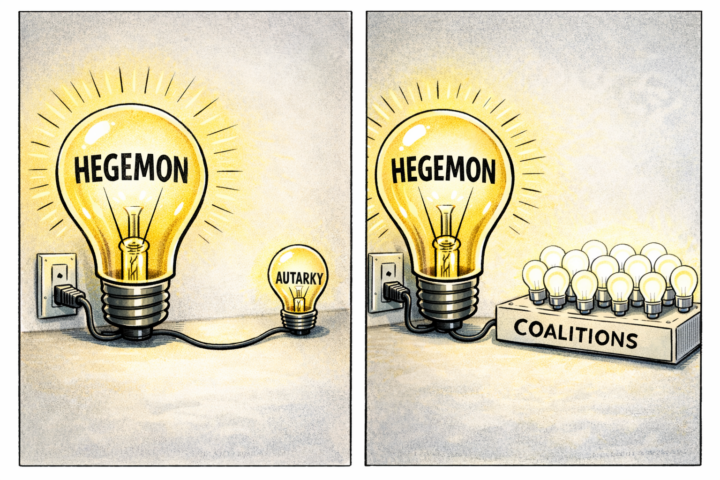
Carney warns against the wrong answer: cutting yourself off from others. Trying to be completely self-sufficient, whether as a country or a business, is expensive and fragile. The real solution is not to leave these systems, but to limit the power they give to a few.

For countries, this means spreading out risks, agreeing on common rules, and working together to be stronger. For businesses under big platforms, the steps are much the same:

  • Multi-channel sales rather than single-platform dependence
  • Direct customer relationships
  • Shared logistics and payment infrastructure
  • Collective bargaining and standards-setting among suppliers

The aim is not to run away, but to have more choices. It’s not about being perfect, but about having more power to negotiate.


The Fragility of Legitimacy

One of Carney’s key points is that power based on routine compliance is actually weak. Those in charge last not because there are no other options, but because it seems impossible for others to work together.

That perception can change.

Middle powers do not overcome stronger ones just by fighting. They do it by telling the truth, refusing to give respect to those who don’t deserve it, reducing their dependence, and working together. The same is true for digital platforms. Their power comes not just from technology or size, but from the shared belief, rarely questioned, that there is no other way.

When people stop believing there are no alternatives, new systems become possible.


Taking the Sign Out of the Window

When Carney says to “take the sign out of the window,” he is really asking for honesty: to stop pretending to support systems that no longer work, and to start creating ones that do.

In geopolitics, this means admitting the old system is over and acting in line with that reality. In the digital world, it means seeing that platform neutrality is a myth, and responding not with longing for the past or anger, but by working together, being practical, and building new ways to organize.

The old deals are finished. Now, both countries and companies must decide: will we keep pretending, or will we finally start building something real?


**Canadian Prime MInister Mark Carney’s Davos 2026 Speech

Thank you, Larry.

It’s a pleasure – and a duty – to be with you at this turning point for Canada and for the world.

Today, I’ll talk about the rupture in the world order, the end of a nice story, and the beginning of a brutal reality where geopolitics among the great powers is not subject to any constraints.

But I also submit to you that other countries, particularly middle powers like Canada, are not powerless. They have the capacity to build a new order that embodies our values, like respect for human rights, sustainable development, solidarity, sovereignty, and territorial integrity of states.

The power of the less powerful begins with honesty.

Every day we are reminded that we live in an era of great power rivalry. That the rules-based order is fading. That the strong do what they can, and the weak suffer what they must.

This aphorism of Thucydides is presented as inevitable – the natural logic of international relations reasserting itself. And faced with this logic, there is a strong tendency for countries to go along to get along. To accommodate. To avoid trouble. To hope that compliance will buy safety.

It won’t.

So, what are our options?

In 1978, the Czech dissident Václav Havel wrote an essay called The Power of the Powerless. In it, he asked a simple question: how did the communist system sustain itself?

His answer began with a greengrocer. Every morning, this shopkeeper places a sign in his window: “Workers of the world, unite!” He does not believe it. No one believes it. But he places the sign anyway – to avoid trouble, to signal compliance, to get along. And because every shopkeeper on every street does the same, the system persists.

Not through violence alone, but through the participation of ordinary people in rituals they privately know to be false.

Havel called this “living within a lie.” The system’s power comes not from its truth but from everyone’s willingness to perform as if it were true. And its fragility comes from the same source: when even one person stops performing — when the greengrocer removes his sign — the illusion begins to crack.

It is time for companies and countries to take their signs down.

For decades, countries like Canada prospered under what we called the rules-based international order. We joined its institutions, praised its principles, and benefited from its predictability. We could pursue values-based foreign policies under its protection.

We knew the story of the international rules-based order was partially false. That the strongest would exempt themselves when convenient. That trade rules were enforced asymmetrically. And that international law applied with varying rigour depending on the identity of the accused or the victim.

This fiction was useful, and American hegemony, in particular, helped provide public goods: open sea lanes, a stable financial system, collective security, and support for frameworks for resolving disputes.

So, we placed the sign in the window. We participated in the rituals. And largely avoided calling out the gaps between rhetoric and reality.

This bargain no longer works.

Let me be direct: we are in the midst of a rupture, not a transition.

Over the past two decades, a series of crises in finance, health, energy, and geopolitics laid bare the risks of extreme global integration.

More recently, great powers began using economic integration as weapons. Tariffs as leverage. Financial infrastructure as coercion. Supply chains as vulnerabilities to be exploited.

You cannot “live within the lie” of mutual benefit through integration when integration becomes the source of your subordination.

The multilateral institutions on which middle powers relied— the WTO, the UN, the COP – the architecture of collective problem solving – are greatly diminished.

As a result, many countries are drawing the same conclusions. They must develop greater strategic autonomy: in energy, food, critical minerals, in finance, and supply chains.

This impulse is understandable. A country that cannot feed itself, fuel itself, or defend itself has few options. When the rules no longer protect you, you must protect yourself.

But let us be clear-eyed about where this leads. A world of fortresses will be poorer, more fragile, and less sustainable. And there is another truth: if great powers abandon even the pretence of rules and values for the unhindered pursuit of their power and interests, the gains from “transactionalism” become harder to replicate. Hegemons cannot continually monetize their relationships.

Allies will diversify to hedge against uncertainty. Buy insurance. Increase options. This rebuilds sovereignty – sovereignty that was once grounded in rules, but will be increasingly anchored in the ability to withstand pressure.

As I said, such classic risk management comes at a price, but that cost of strategic autonomy, of sovereignty, can also be shared. Collective investments in resilience are cheaper than everyone building their own fortress. Shared standards reduce fragmentation. Complementarities are positive sum.

The question for middle powers, like Canada, is not whether to adapt to this new reality. We must. The question is whether we adapt by simply building higher walls – or whether we can do something more ambitious.

Canada was amongst the first to hear the wake-up call, leading us to fundamentally shift our strategic posture.

Canadians know that our old, comfortable assumption that our geography and alliance memberships automatically conferred prosperity and security is no longer valid.

Our new approach rests on what Alexander Stubb has termed “values-based realism” – or, to put it another way, we aim to be principled and pragmatic.

Principled in our commitment to fundamental values: sovereignty and territorial integrity, the prohibition of the use of force except when consistent with the UN Charter, respect for human rights.

Pragmatic in recognising that progress is often incremental, that interests diverge, that not every partner shares our values. We are engaging broadly, strategically, with open eyes. We actively take on the world as it is, not wait for a world we wish to be.

Canada is calibrating our relationships so their depth reflects our values. We are prioritising broad engagement to maximise our influence, given the fluidity of the world order, the risks that this poses, and the stakes for what comes next.

We are no longer relying on just the strength of our values, but also on the value of our strength.

We are building that strength at home.

Since my government took office, we have cut taxes on incomes, capital gains and business investment, we have removed all federal barriers to interprovincial trade, and we are fast-tracking a trillion dollars of investment in energy, AI, critical minerals, new trade corridors, and beyond.

We are doubling our defence spending by 2030 and are doing so in ways that builds our domestic industries.

We are rapidly diversifying abroad. We have agreed a comprehensive strategic partnership with the European Union, including joining SAFE, Europe’s defence procurement arrangements.

We have signed twelve other trade and security deals on four continents in the last six months.

In the past few days, we have concluded new strategic partnerships with China and Qatar.

We are negotiating free trade pacts with India, ASEAN, Thailand, Philippines, Mercosur.

To help solve global problems, we are pursuing variable geometry— different coalitions for different issues, based on values and interests.

On Ukraine, we are a core member of the Coalition of the Willing and one of the largest per-capita contributors to its defence and security.

On Arctic sovereignty, we stand firmly with Greenland and Denmark and fully support their unique right to determine Greenland’s future.

Our commitment to Article 5 is unwavering. We are working with our NATO allies (including the Nordic Baltic 8) to further secure the alliance’s northern and western flanks, including through Canada’s unprecedented investments in over-the-horizon radar, submarines, aircraft, and boots on the ground. Canada strongly opposes tariffs over Greenland and calls for focused talks to achieve shared objectives of security and prosperity for the Arctic.

On plurilateral trade, we are championing efforts to build a bridge between the Trans-Pacific Partnership and the European Union, creating a new trading block of 1.5 billion people. On critical minerals, we are forming buyer’s clubs anchored in the G7 so that the world can diversify away from concentrated supply. On AI, we are cooperating with like-minded democracies to ensure we will not ultimately be forced to choose between hegemons and hyperscalers.

This is not naive multilateralism. Nor is it relying on diminished institutions. It is building the coalitions that work, issue by issue, with partners who share enough common ground to act together.

In some cases, this will be the vast majority of nations. And it is creating a dense web of connections across trade, investment, culture on which we can draw for future challenges and opportunities.

Middle powers must act together because if you are not at the table, you are on the menu.

Great powers can afford to go it alone. They have the market size, the military capacity, the leverage to dictate terms. Middle powers do not.

But when we only negotiate bilaterally with a hegemon, we negotiate from weakness. We accept what is offered. We compete with each other to be the most accommodating. T

his is not sovereignty. It is the performance of sovereignty while accepting subordination. In a world of great power rivalry, the countries in between have a choice: to compete with each other for favour or to combine to create a third path with impact.

We should not allow the rise of hard power to blind us to the fact that the power of legitimacy, integrity, and rules will remain strong — if we choose to wield it together. Which brings me back to Havel.

What would it mean for middle powers to “live in truth”? It means naming reality. Stop invoking the “rules-based international order” as though it still functions as advertised. Call the system what it is: a period of intensifying great power rivalry, where the most powerful pursue their interests using economic integration as a weapon of coercion.

It means acting consistently. Apply the same standards to allies and rivals. When middle powers criticise economic intimidation from one direction but stay silent when it comes from another, we are keeping the sign in the window. It means building what we claim to believe in. Rather than waiting for the old order to be restored, create institutions and agreements that function as described. And it means reducing the leverage that enables coercion.

Building a strong domestic economy should always be every government’s priority. Diversification internationally is not just economic prudence; it is the material foundation for honest foreign policy. Countries earn the right to principled stands by reducing their vulnerability to retaliation.

Canada has what the world wants. We are an energy superpower. We hold vast reserves of critical minerals. We have the most educated population in the world. Our pension funds are amongst the world’s largest and most sophisticated investors. We have capital, talent, and a government with the immense fiscal capacity to act decisively. And we have the values to which many others aspire.

Canada is a pluralistic society that works. Our public square is loud, diverse, and free.

Canadians remain committed to sustainability. We are a stable, reliable partner—in a world that is anything but—a partner that builds and values relationships for the long term.

Canada has something else: a recognition of what is happening and a determination to act accordingly. We understand that this rupture calls for more than adaptation. It calls for honesty about the world as it is. We are taking the sign out of the window. The old order is not coming back.

We should not mourn it. Nostalgia is not a strategy. But from the fracture, we can build something better, stronger, and more just. This is the task of the middle powers, who have the most to lose from a world of fortresses and the most to gain from a world of genuine cooperation.

The powerful have their power. But we have something too – the capacity to stop pretending, to name reality, to build our strength at home, and to act together. That is Canada’s path. We choose it openly and confidently. And it is a path wide open to any country willing to take it with us.

Author’s Note: Assist by ChatGPT and Grammarly

Dare to Dream: The 28th Amendment

Reading Time: 4 minutes

Proposed Twenty-Eighth Amendment to the Constitution of the United States

Section 1 — Unanimous Judicial Authority

No decision, judgment, opinion, order, or decree of the Supreme Court of the United States shall have force of law unless joined unanimously by all Justices then in active service and eligible to participate.

In the absence of unanimous consent, the decision of the court or courts below shall stand without precedential effect.

Section 2 — Opinions and Dissents

Nothing in this article shall prohibit any Justice from issuing concurring, dissenting, or advisory opinions.
Such opinions shall have no binding legal effect unless accompanied by unanimous consent as required in Section 1.

Section 3 — Department of Justice

The Department of Justice is hereby constituted as an independent judicial enforcement body under the supervisory authority of the Supreme Court of the United States.

The Attorney General of the United States shall be appointed by the Supreme Court of the United States by unanimous consent of all Justices then in active service and eligible to participate, and may be removed only by unanimous consent of the Supreme Court, pursuant to procedures established by law.

Section 4 — Mandatory Retirement

No person shall serve as a Justice of the Supreme Court of the United States beyond the age of seventy-five years.

A Justice attaining the age of seventy-five shall retire at the conclusion of the Supreme Court term during which such age is reached.

Section 5 — Implementation

Congress shall have the power to enforce and implement this article by appropriate legislation, provided that no such legislation shall impair the independence, unanimity requirement, or supervisory authority of the Supreme Court as defined within this amendment.

Section 6 — Applicability

This article shall apply to all cases pending on or after the date of ratification.
Any Justice serving at the time of ratification who has attained the age of seventy-five years may complete the then-current Supreme Court term.

A Structural Amendment to Restore Judicial Legitimacy and the Rule of Law

This amendment proposes a deliberate restructuring of constitutional power in response to an unmistakable problem: the politicization of justice itself. Over time, the Supreme Court has come to be perceived not as an impartial arbiter of law, but as a rotating instrument of ideological control. Simultaneously, the Department of Justice—endowed with immense coercive power—has increasingly functioned as an extension of executive will, vulnerable to political priorities, selective enforcement, and retaliatory prosecution.

The amendment responds to these failures not through moral appeals, but through structural design.


Unanimity as a Constitutional Safeguard

At the core of the amendment is a simple principle: no legal ruling should bind an entire nation unless it endures the scrutiny of every Justice entrusted with constitutional judgment.

Unanimous consent has long been recognized as essential where liberty is most at risk. In criminal trials, unanimity is required because the cost of error is irreparable. Constitutional interpretation carries a similar gravity. Supreme Court rulings reshape civic life, reorder rights, and alter the balance of governmental power. When narrow majorities render such decisions, they invite instability, erosion of trust, and cycles of reversal that track electoral change rather than judicial clarity.

Requiring unanimity does not silence disagreement. Justices remain free—indeed encouraged—to express dissenting views. What changes is the consequence of division. In the absence of consensus, the Court refrains from imposing a national rule and allows existing law to stand. This assures that constitutional change arises only from shared conviction rather than transient alignment.

The result is a judiciary that persuades rather than commands, stabilizes rather than oscillates, and earns legitimacy through restraint.


Depoliticizing Justice by Deweaponizing Enforcement

Just as important is the amendment’s restructuring of the Department of Justice.

Under the current framework, the Department of Justice exists within the Executive Branch, subject to presidential appointment, influence, and removal. While safeguards exist, the structural reality remains: prosecutorial discretion—among the most powerful tools of government—is entangled with political authority.

This amendment breaks that entanglement.

By placing the Department of Justice under the supervisory authority of the Supreme Court, the amendment redefines prosecution as a legal function rather than a political instrument. Enforcement of law becomes accountable to constitutional interpretation, not electoral mandate. The Attorney General is appointed and overseen by the judiciary, guaranteeing continuity, neutrality, and insulation from partisan cycles.

This shift does not weaken law enforcement. It strengthens it by anchoring prosecutorial power to legal obligation rather than political opportunity. The amendment thus removes the incentive to weaponize justice against opponents or shield allies, renewing public confidence that the law is applied evenly and without fear or favor.


Judicial Renewal Without Political Dependence

Mandatory retirement at age seventy-five assures that judicial authority remains vigorous, current, and accountable to developing legal understanding without resorting to elections or term limits that would undermine independence. This provision prevents strategic retirements, reduces vacancy manipulation, and guarantees periodic renewal of the Court without politicizing tenure.


A Court That Cannot Be Captured

Taken together, these reforms create a Supreme Court that cannot be captured by ideology, timing, or executive pressure. The absence of majority rule eliminates incentives for partisan appointments aimed at tipping narrow balances. The separation of prosecution from executive control removes the threat of political coercion. The requirement of unanimity assures that national rules emerge only where constitutional meaning is clear enough to command collective assent.

This amendment does not promise faster justice. It promises truer justice.

It accepts that restraint is not weakness, that disagreement is not failure, and that power should advance only where consensus exists. In doing so, it reaffirms the Constitution not as a battlefield of factions, but as a shared legal foundation worthy of enduring trust.