Author’s Note: A great introduction to MMT can be found at https://findingmoneyfilm.com/. I suggest it as a prerequisite to the essay that follows.
Author’s Note: This addition to the previous post, “How the Dollar Rules the World,” was triggered by Elon Musk’s claim that energy is the true currency of the world and that bitcoin is a physics-based currency. I didn’t hate the idea at first glance, but now I have two primary objections. First, Bitcoin is incredibly energy wasteful and for no good reason. Second, MMT says that taxation drives currency demand. Bitcoin has no taxation and provides no services to drive demand, other than speculation, tax evasion, and the concealment of illegal activities. It is not a real currency. But those observations, along with further conversations with ChatGPT, led me to add the following addition to the original article and to make slight revisions to the 10-point plan.
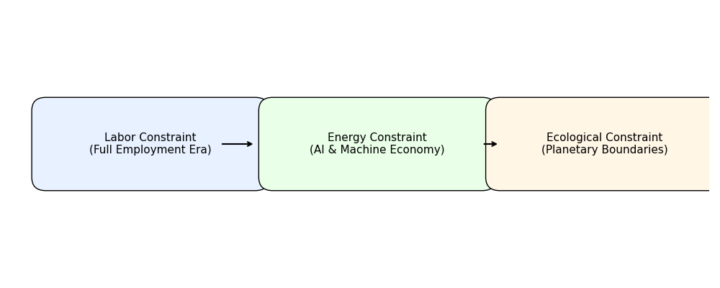
Rethinking real resource constraints in an AI economy requires emphasizing that energy and ecological limits are now central to economic policy, shifting the focus from traditional labor-based constraints. For most of the twentieth century, governments treated labor as the central fundamental constraint in monetary policy. Full employment was the practical signal that an economy was close to its limits. If everyone who wanted a job had one, then additional public spending risked running ahead of real capacity.
But this proxy begins to break down in an economy increasingly shaped by automation and artificial intelligence. When autonomous agents and machines can supply a growing share of marketable labor, the link between employment and capacity weakens. A nation could have high unemployment without productivity bottlenecks, yet still face bottlenecks in energy, computing, materials, or ecological resilience.
Modern Monetary Theory argues that money creation must be guided not by arbitrary financial limits but by real resources. If labor ceases to be the binding resource, then policy must find its bearings elsewhere.
A tempting idea is to tie the money supply directly to the nation’s energy supply, creating a kind of “energy standard” in which fiscal expansion rises and falls with available power. But a strict peg behaves much like the old gold standard: it forces contraction precisely when the real economy is under strain. If an energy shortage hits—whether from a heat wave, drought, or grid disruption—the peg would require the government to reduce spending in lockstep, imposing austerity on top of an existing shock. And in the opposite direction, an energy peg would delay public investment during a renewable build-out, because it only permits fiscal expansion after new capacity already exists. Transitions, however, require spending before new capacity is online. For both reasons, a rigid resource peg is too brittle for a dynamic, decarbonizing economy.
Bitcoin is often described as a “physics-based” currency because it requires significant computational power and energy to validate transactions and secure the network. But this is not the same as grounding a currency in real resources. Bitcoin burns energy; it does not measure or coordinate it. The energy consumed in mining reflects competition among miners, not the productive capacity of the economy or the planet’s ecological limits. As a result, Bitcoin’s energy use is decoupled from economic need—it can soar during recessions, collapse during booms, and remains oblivious to environmental stress. Nor does Bitcoin adjust its supply in response to demand, resource scarcity, or investment needs. Its fixed issuance schedule makes it inherently pro-cyclical: it tightens during downturns and loosens nothing during inflation, acting more like a digital gold standard than a responsive monetary system. In this sense, Bitcoin is “physics-based” only in the most literal and least helpful way—it consumes energy without referencing or regulating the resources that matter. A currency aligned with real constraints must help society navigate energy availability, ecological boundaries, and productive capacity; Bitcoin does none of these things.
What’s needed instead is a flexible ecological anchor—one that uses energy and environmental indicators as guides rather than hard limits, allowing fiscal policy to remain countercyclical while still respecting the realities of an AI-driven, resource-constrained world. A single resource cannot capture the full spectrum of real constraints — soil, water, minerals, climate stability, and biodiversity all shape economic possibilities. A more robust approach recognizes that the economy is shifting from a labor-limited world to an energy-limited and ultimately an ecologically-limited one. Labor is still vital for care, creativity, and governance, but it is no longer the bottleneck: energy and ecological stability increasingly are.
In this light, the goal is not to fix the currency to a single biophysical input but to develop a flexible ecological system in which taxation, tariffs, and public investment respond directly to indicators such as carbon emissions, habitat loss, and water scarcity, guiding policy within planetary boundaries.
This shift opens the door to a humane transition. A Job Guarantee could ensure purposeful work while labor is still necessary, while a Universal Basic Income could ensure participation and dignity as automation reduces the demand for labor. Resource-use taxes and carbon border adjustments could prevent ecological dumping and align global trade with climate goals. An international clearing union can foster hope and trust by helping developing nations grow within ecological constraints rather than under the weight of austerity, emphasizing collective progress.
In short, the real limits of the future lie in energy and ecology, not in the number of people formally employed. A sovereign currency must be managed with those realities in mind.
Classic macroeconomics teaches that governments should act countercyclically, expanding spending when the economy slows, and pulling back when it overheats. In the postwar era, the proxy for “overheating” was simple: full employment. If everyone who wanted a job had one, the economy was assumed to be operating near its productive limit. But in a world transformed by automation and climate risk, full employment no longer tells the whole story. AI can expand productive capacity even as human labor becomes less central. Meanwhile, the real bottlenecks increasingly arise not from labor scarcity but from energy constraints, material shortages, and ecological limits — droughts, heatwaves, pollution shocks, and brittle grids.
A resource-anchored approach does not abandon countercyclical logic — it strengthens it by tying fiscal expansion and contraction to the economy’s physical condition rather than abstract indicators. When the energy system is under strain, when emissions spike, or when biodiversity loss accelerates, the economy is effectively “hot,” regardless of unemployment levels. When energy demand falls, when supply chains loosen, or when ecological stress eases, the economy has slack, even if unemployment remains elevated.
Under this framework, fiscal policy becomes countercyclical in a more profound sense:
- Resource Slack — when renewable capacity is underutilized, when emissions fall, or when water and materials are plentiful — signals room for fiscal expansion, especially investments in green infrastructure, resilience, and social support.
- Resource Stress — when energy grids strain, when climate impacts accelerate, or when supply chains choke — signals the need to temper broad fiscal expansion while steering spending toward efficiency, restoration, and mitigation.
This dynamic system retains the spirit of traditional countercyclical policy while adapting it to the new realities of an AI-enabled, ecologically bounded world. Instead of reacting to labor data that increasingly reflects automation more than capacity, it responds to the actual limits of the real economy — energy, materials, and ecosystems — the things no government can print.
In doing so, it turns countercyclical policy into a stabilizing force not just for business cycles, but for long-term ecological and economic resilience.
Ten-Point Plan (Integrating Ecology, Automation, and Global Justice)
1. Insure People, Not Sectors
Ensure that individuals, not industries, are protected as the economy evolves with universal healthcare, income stabilizers, childcare, and transition support.
2. A Dynamic Job Guarantee Focused on Regeneration
Guarantee jobs with a program that offers dignified public work in environmental restoration, caregiving, infrastructure renewal, and climate adaptation. Jobs serve planetary health, not just employment metrics.
3. Build a Pathway Toward Universal Basic Income
Phase in an income floor as automation reduces labor demand. Productivity gains become a shared dividend, supporting dignity, creativity, and community participation.
4. Invest in Real Productive Capacity
Channel public investment into renewable energy, advanced manufacturing, AI governance, electrified transportation, water systems, and resilient supply chains.
5. Anchor Fiscal Policy to Ecological Reality
Replace labor-based inflation proxies with ecological indicators: carbon budgets, soil and water stress, biodiversity loss, and renewable capacity. Fiscal space expands with environmental regeneration and contracts with ecological strain.
6. Shift the Tax Base from Labor to Resource Use
Phase out taxes on human work and exchange of goods; raise them on carbon, material extraction, pollution, and land speculation. Align incentives with sustainability.
7. Use Trade Policy to Prevent Ecological Dumping
Adopt carbon border adjustments and energy-use tariffs to prevent pollution offshoring and reward clean production globally. Import goods for the right reasons.
8. Create a Global Green Clearing Union
Provide developing nations access to a shared reserve asset — a “proxy sovereign currency” — tied to green investment and climate resilience, not austerity. Replace debt traps with development pathways.
9. Rebuild Political Cohesion at Home
Reform democratic institutions so that policy reflects public purpose: election reform, anti-gerrymandering rules, campaign finance transparency, and civic investment.
10. Use the Dollar for Regeneration, Not Extraction
Direct the benefits of the reserve currency system toward healing ecosystems, stabilizing the climate, uplifting communities, and supporting global cooperation. Treat fiscal capacity as responsibility, not indulgence.
Author’s Note: Credit to ChatGPT 5.0 for assist and images.