
From Domestication to Globalization
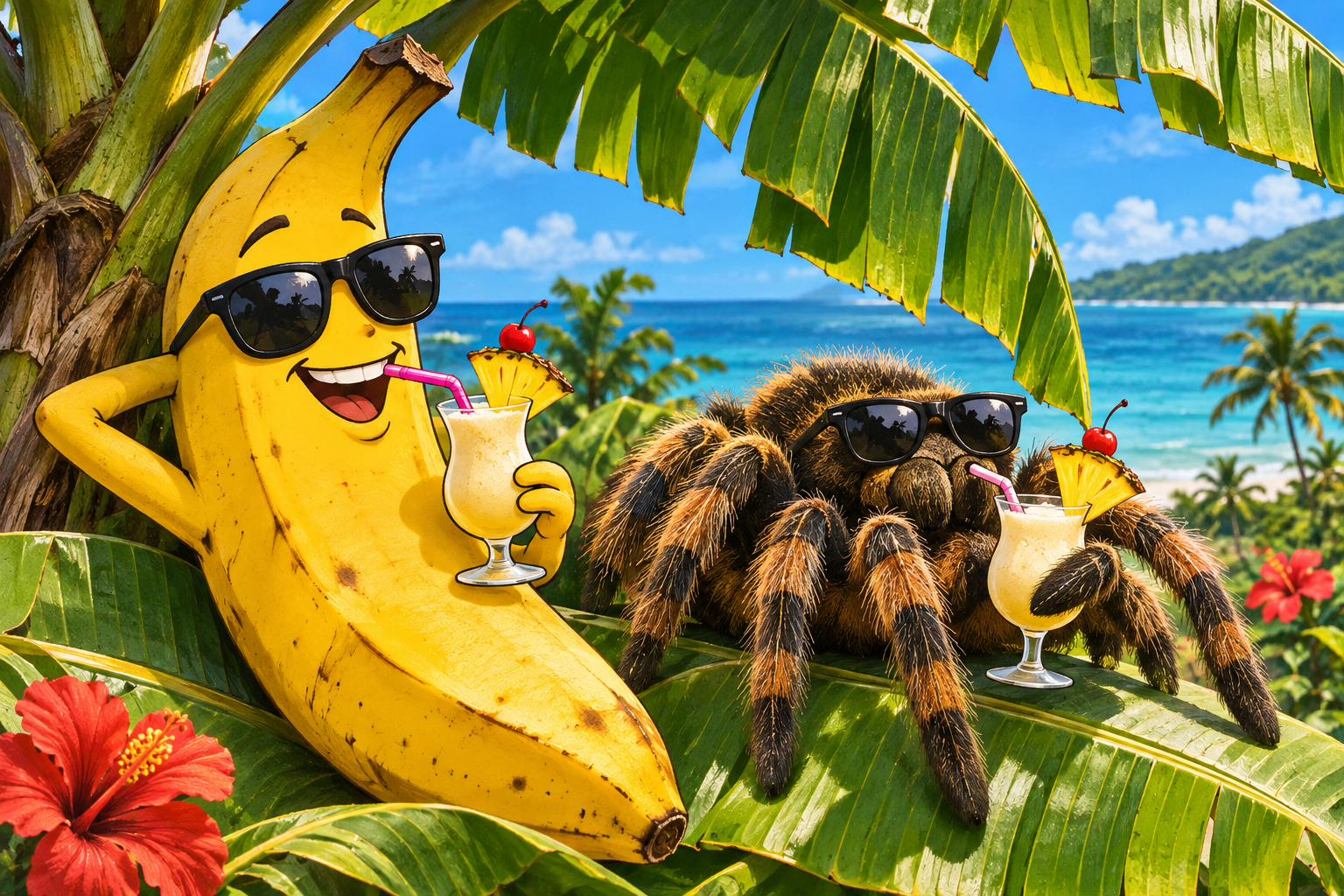
I began as a whisper in the rich, dark soil of St. Mary, Jamaica. Nestled deep inside my mother plant’s underground corm, I was just a rising stem pushing through her tightly wrapped core. When I finally burst into the blinding Jamaican sunshine, my first roommate was a resident banana spider—a massive, furry tarantula who took up residence right above my node. We didn’t talk much, but we shared a mutual respect for boundary lines.
I come from a distinguished family. My ancestors were domesticated thousands of years ago in Southeast Asia and New Guinea, where enterprising humans discovered that certain wild bananas produced edible fruit with fewer troublesome seeds. Through generations of selection and vegetative propagation, they transformed a rather uncooperative wild plant into a remarkably accommodating agricultural companion. My ancestors eventually traveled westward across the Indian Ocean to Africa and, much later, across the Atlantic to the Americas.
We bananas have been accompanying human civilization for millennia. Or perhaps civilization has been accompanying us. It’s difficult to establish who domesticated whom.
The banana’s arrival in the Caribbean was part of the great biological exchange that followed Columbus. Spanish and Portuguese colonizers brought bananas to the Americas during the sixteenth century, where the plants flourished in tropical climates. By the time I arrived in St. Mary, my family had become thoroughly Jamaican, although, like so much of the island’s agriculture, our roots lay in the complicated history of migration, colonization, and plantation cultivation.
Over the next few weeks, my purple-red heart unfolded, peeling back its heavy petals. My fingers grew plump and green, reaching upward against gravity toward the Caribbean sun in a beautiful, stubborn curve. I took immense pride in my development.
I wasn’t just any backyard fruit. I was a premium specimen.
My family had come a long way since the days when bananas were largely consumed near where they grew. For most of human history, we were terrible international travelers. We ripened too quickly, bruised too easily, and had an unfortunate tendency to turn into brown mush before reaching distant markets.
That changed in the nineteenth century with the arrival of steamships, refrigerated transportation, and the industrial organization of tropical agriculture. Jamaica became an important supplier to the growing British banana market, particularly after the establishment of regular refrigerated shipping services in the early twentieth century. Meanwhile, American entrepreneurs were building an entirely different empire across Central America and the Caribbean.
The Boston Fruit Company, founded in 1885, eventually merged with other interests to form the United Fruit Company in 1899. Its plantations, railroads, ports, steamships, and political influence became so extensive that entire nations acquired the unfortunate designation of banana republics.
I prefer to think of this as an early demonstration of vertical integration.
Of course, some of my relatives were less fortunate. The original superstar of the international banana trade was the Gros Michel, a handsome, robust fellow with excellent flavor and a thick skin ideally suited to shipping. Unfortunately, the Gros Michel proved vulnerable to Panama disease, a soilborne fungal infection that devastated plantations during the twentieth century.
The industry responded not by abandoning monoculture but by replacing Gros Michel with another variety resistant to the prevailing strain of the disease: the Cavendish.
That’s my family.
We Cavendishes are essentially clones, propagated vegetatively rather than through seeds. This gives us the marvelous advantage of uniformity. We ripen predictably, fit neatly into standardized boxes, and meet the exacting specifications of international retailers. Unfortunately, genetic uniformity also makes us vulnerable to diseases that can spread through populations with little inherited resistance.
A newer strain of Panama disease, Tropical Race 4, now threatens Cavendish cultivation in several parts of the world.
Personally, I prefer not to dwell on family medical history.
When the auditor from FLO-CERT inspected the farm’s compliance with Fairtrade standards, I practically stood at attention. I was destined for the elite life of a certified Fairtrade banana.
Fairtrade represented another milestone in the long evolution of our relationship with humanity. The old banana companies had built their empires by controlling land, transportation, and access to markets. By the late twentieth century, however, consumers were beginning to ask awkward questions about wages, working conditions, environmental damage, and who actually benefited from the global banana trade.
Fairtrade certification emerged as one answer. It established standards for producers and traders, including labor protections, minimum pricing arrangements, and an additional premium intended for community and producer investments.
I knew my journey would help finance Jamaican schoolhouses and climate-resilient farming gear—or at least contribute to a fund whose spending priorities would be determined collectively.
I carried myself with the dignity befitting a high-end agricultural diplomat.
My brother, on the other hand, had much lower ambitions.
He was obsessed with the golden age of American slapstick comedy. He used to brag that he was going to skip the food supply chain entirely, make it into show business, and spend his retirement getting people to slip and fall on theater stages.
He claimed our greatest contribution to Western civilization was not nutrition, international commerce, or agricultural development, but the banana peel gag.
I reminded him that bananas had helped transform the diets of entire populations, supported international trade worth billions of dollars, and contributed to the economic development of tropical countries.
He replied that none of those achievements had ever made Charlie Chaplin fall on his backside.
Last I heard, he got packed into a generic crate bound for a prop department in Hollywood.
Personally, I found it a bit pedestrian. Slapstick is a dying art; global economic empowerment is forever.

Then came the morning of the machete.
A sharp, swift strike severed our heavy bunch. As I was gently laid onto a padded trailer, I looked up at the canopy one last time.
Adieu, tarantula, I thought, offering a silent nod to my furry tenant. Keep the estate in order.
I was rushed to a bustling packing shed where clean water washed away my sticky sap. Workers separated our hands, inspected our skins, removed those of us with unacceptable blemishes, and arranged the survivors according to the precise requirements of our overseas customers.
I passed with flying colors.
A worker tucked me into a ventilated cardboard chariot, its markings identifying the producer, origin, and certification status of its contents.
The modern banana supply chain is a miracle of coordination. Harvest schedules, packing operations, refrigerated trucking, shipping containers, customs documentation, wholesale distribution, and supermarket inventory systems must all work together to deliver a fruit that remains green until the precise moment its purchaser wishes it to become yellow.
Our ancestors depended on the seasons. We depend on logistics. I considered this a considerable improvement.
The darkness lasted for days. I was loaded into a refrigerated steel container, drifting into a deep sleep as the temperature settled near 13°C. The controlled atmosphere slowed my metabolism, keeping me green and unripe while I listened to the rhythmic, distant thrum of a cargo ship crossing the Caribbean and heading toward an American port.
My predecessors had traveled in the holds of steamships operated by companies that owned not merely the ships but often the plantations, railroads, warehouses, and docks that supplied them.
Today’s industry is more fragmented, although a handful of multinational fruit companies, shipping operators, importers, and supermarket chains still exert enormous influence over how bananas move and how their value is divided.
I had heard that a banana purchased for a dollar in an American supermarket might return only a small fraction of that price to the farm where it grew. The remainder would be distributed among shipping companies, importers, ripeners, wholesalers, retailers, and the many other participants who contributed to my journey.
I found this entirely reasonable. After all, I was only responsible for growing. Everyone else was responsible for making me valuable.
I woke up weeks later in a high-tech ripening room somewhere in America. A carefully controlled dose of ethylene gas filled the air, acting as a chemical wake-up call that told my body it was time to transform.
Ethylene, a natural plant hormone, was one of the great discoveries that enabled the modern fruit industry to separate the geography of cultivation from the timing of consumption.
My complex starches converted into simple sugars. My deep chlorophyll green dissolved into a brilliant, aristocratic yellow.
For thousands of years, humans had selected bananas for their flavor, texture, and productivity. For the last century and a half, they had increasingly selected and managed us for our ability to survive transportation, withstand handling, ripen predictably, and satisfy the aesthetic expectations of distant consumers.
I had become the perfect industrial fruit. Seedless, standardized, genetically uniform, and available year-round. The culmination of millennia of domestication. One might even say that I had evolved beyond nature.
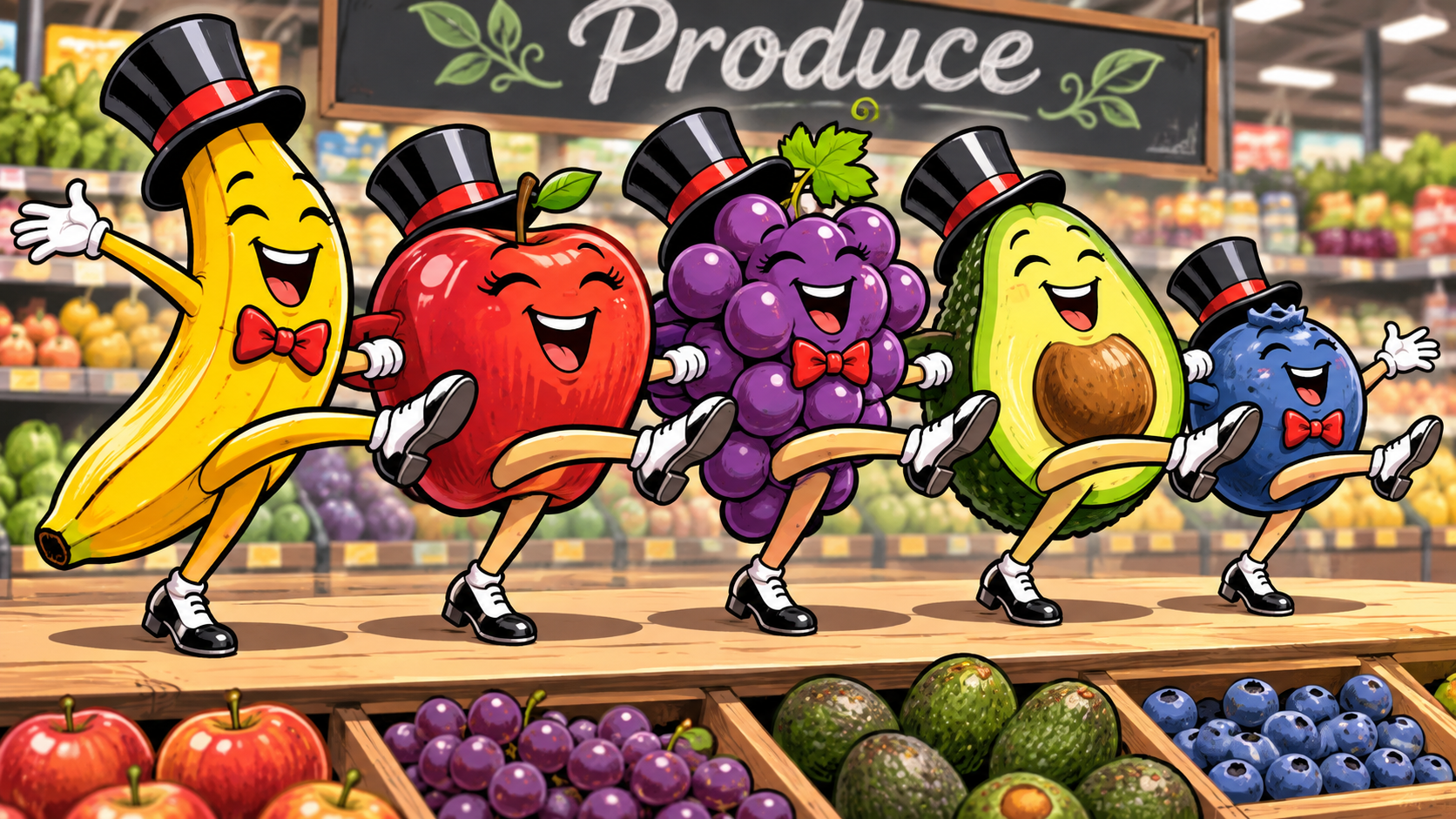
When the box finally opened, I was stacked onto a pristine, angled display in a sprawling American supermarket. The fluorescent lights overhead were a poor substitute for the Jamaican sun, but under my Fairtrade banner, I was the undisputed star of the produce aisle.
Shoppers eyed me with reverence.
I surveyed my surroundings with satisfaction. There were apples from Washington, grapes from Chile, avocados from Mexico, and blueberries from Peru. We had all been harvested in distant places, transported through intricate networks, and assembled into a single display of agricultural abundance.
The modern supermarket was a triumph over geography and seasonality.
Somewhere in the world, farmers planted and harvested. Somewhere else, trucks moved, ships sailed, and warehouses hummed. All so that a suburban American could purchase a banana on a Tuesday afternoon in November without giving the slightest thought to where bananas came from.
I regarded this indifference as the ultimate achievement of civilization.
The end came quickly, right in the supermarket parking lot.
A hungry commuter snatched my bunch, paid my premium price, and immediately gave my crown a sharp tug. My yellow skin split flawlessly down the seam. My sweet, creamy flesh was devoured in three bites, fulfilling my high-quality destiny.
Three bites.
Thousands of years of domestication. Centuries of colonial agriculture. The rise and fall of banana empires. The devastation of the Gros Michel. The triumph of the Cavendish. Refrigerated shipping, containerization, computerized logistics, ethylene ripening, international certification, and a global retail system of almost unimaginable complexity.
Three bites.
And then, with a casual flick of a wrist, my empty peel was tossed aside, landing with a soft thud near the supermarket curb.
Now I lie here on the cold asphalt, feeling the chill of a foreign wind. My bright yellow skin is already bruising to black, beginning its slow decomposition a long way from the soil of St. Mary.
I look around the parking lot, scanning the ground. There are no cameras, no vaudeville actors, and no pie-throwing contests in sight. If my brother were here, he’d be bored to tears.
But as for me?
I brought premium value to my farm, crossed an ocean in suspended animation, and lived a life of pure, certified excellence. I was bred for uniformity, cultivated for productivity, transported for efficiency, ripened on command, marketed for ethical consumption, and consumed for convenience.
Not a bad run for a giant herb.
As I watch an elderly gentleman approach the curb with his arms full of groceries, I cannot help but wonder whether my brother might have had the better business plan.
Author’s Note: Inspired by a visit to the garden at Konoko Falls. First-person banana is my contribution. ChatGPT did most of the heavy lifting and images.